
Written by  Maria Torres · Updated 2026-11-20
- Category
- Churches & Basilicas
Santa Maria in Trastevere is one of the oldest churches in Rome dedicated to the Virgin Mary, on a site linked to a house church founded by Pope Callixtus I around 220. The present basilica was largely rebuilt under Pope Innocent II in the 12th century, and its mosaics are the reason to come: in the apse, the Coronation of the Virgin (1130–1143) shows Innocent holding a model of the church, and below it Pietro Cavallini's scenes from the Life of the Virgin date from 1291. The 22 granite columns of the nave came from the Baths of Caracalla. Outside, the octagonal fountain in the piazza already appears on a map of 1472, and it was restored by Carlo Fontana, who also redesigned the portico in 1702.
Quick facts
- Address
- Piazza di Santa Maria in Trastevere, Trastevere
- Metro / train
- Tram 8 · Belli
- Metro / train
- Tram 8 · Trastevere/Mastai
- Admission
- Free
Sources · facts checked on 2026-11-16
What you see
Santa Maria in Trastevere faces the piazza of the same name at the heart of Trastevere, and it is one of the oldest churches in Rome dedicated to the Virgin Mary. From the square you see a portico with statues of four popes on its balustrade, a 12th-century Romanesque bell tower with a small mosaic of the Madonna and Child in a niche near the top, and, high on the façade, a 13th-century mosaic of Mary enthroned nursing the Child, flanked by ten women holding lamps.
Inside, 22 ancient granite columns with Ionic and Corinthian capitals divide the nave from the aisles; they, and the lintel of the entrance door, were taken from the Baths of Caracalla (Terme di Caracalla). Above the nave, Domenichino designed the carved and gilded coffered ceiling in 1617 and painted the Assumption of the Virgin at its center. Most of the floor was relaid by Virginio Vespignani in 1860 in the style of 13th-century Cosmatesque work.
The mosaics of the apse
The upper apse mosaic, made between 1130 and 1143, shows Christ enthroned with his arm around Mary, an early image of the Coronation of the Virgin, with saints on either side; at the far left Pope Innocent II holds a model of the church he rebuilt. Below, a band of mosaic panels by Pietro Cavallini, dated 1291, tells the Life of the Virgin in a series of scenes.
Go up close to the sanctuary to see the details; the nave is long and the light is often low, so the mosaics read better from the steps of the presbytery than from the entrance.
History: from Callixtus to Innocent II
The church grew from a house church associated with Pope Callixtus I, who died in 222, and the early basilica was known as the Titulus Callisti. Pope Julius I rebuilt it on a larger scale in 340. Tradition places here the fons olei, a spring of oil said to have gushed from the ground in 38 BC, an event recorded by the Roman historian Cassius Dio and later by St. Jerome.
Pope Innocent II had the church rebuilt from the ground on its old foundations between 1138 and 1143; Innocent II, Callixtus I and the antipope Anacletus II, Innocent's rival, are among those buried here. In 1702 Clement XI commissioned Carlo Fontana to redesign the portico, which now shelters fragments of the old church's friezes and early Christian inscriptions.
Chapels
In the Altemps Chapel, built in the late 16th century for Cardinal Marco Sittico Altemps to a design by Martino Longhi the Elder, hangs the Madonna della Clemenza, an encaustic icon probably of Byzantine origin, dated between the 6th and 9th centuries. The Avila Chapel, fifth on the left, has Baroque stucco of 1680 by Antonio Gherardi, noted for its inventive use of hidden light.
The piazza and its fountain
The octagonal fountain in front of the church already appears on a map of 1472, making it one of the oldest in Rome; Carlo Fontana restored it. The piazza is the meeting point of Trastevere and the steps of the fountain are a common place to sit. The Community of Sant'Egidio, the Catholic lay movement founded in Trastevere in 1968, holds its evening prayer in the basilica, and Pope Francis said Mass here on March 11, 2018, for its 50th anniversary.
How to get there
Tram 8 runs along Viale di Trastevere between Piazza Venezia and Casaletto; get off at Belli or Trastevere/Mastai and walk a few blocks west into the piazza. From the historic center you can also walk across the Tiber on Ponte Sisto from Campo de' Fiori, or from the Jewish Ghetto via Isola Tiberina.
Tips for your visit
Allow 30 to 45 minutes. Entry is free. No official visiting hours are published, so check with the parish before you go, and avoid walking around during Mass. Combine it with San Cosimato Market (Mercato di Piazza San Cosimato) a few streets south, Villa Farnesina near the river, or a walk up to the Janiculum Hill (Gianicolo) and the Acqua Paola Fountain (Fontana dell'Acqua Paola).
Frequently asked questions
How do I get to Santa Maria in Trastevere?
Take tram 8 to Belli or Trastevere/Mastai on Viale di Trastevere and walk a few blocks west, or walk across Ponte Sisto from Campo de' Fiori.
Is Santa Maria in Trastevere free to enter?
Yes, entry to the church is free.
What is Santa Maria in Trastevere famous for?
Its mosaics: the 12th-century apse mosaic with Pope Innocent II holding a model of the church, and Pietro Cavallini's Life of the Virgin of 1291.
How old is Santa Maria in Trastevere?
The site is linked to a house church of Pope Callixtus I from around 220. Julius I rebuilt it in 340, and the present building dates from Innocent II's reconstruction of 1138–1143.
Where do the columns in Santa Maria in Trastevere come from?
The 22 granite columns of the nave were taken from the Baths of Caracalla.
Popular tours that include Santa Maria in Trastevere
-
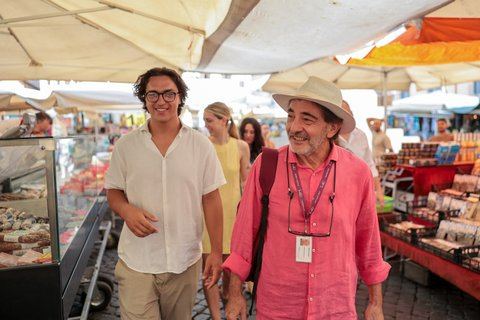 Rome Trastevere Campo de' Fiori Street Food Tour Eat Like a Local
Free cancellation
(opens in a new tab)
-
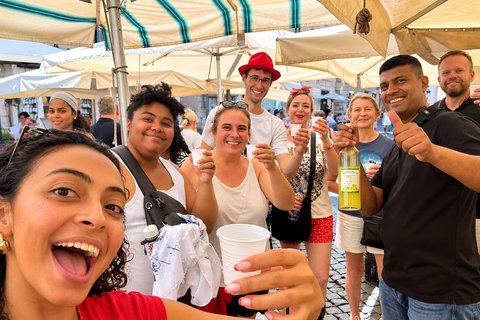 Rome Food Tasting Tour in Trastevere
Free cancellation
(opens in a new tab)
-
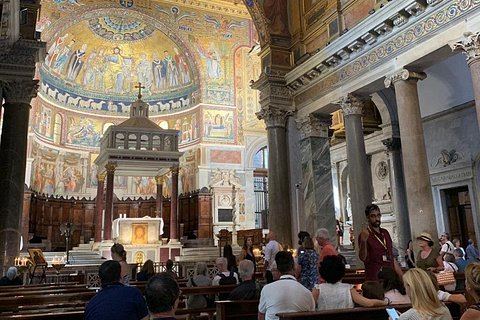 Private Tour - Trastevere and Villa Farnesina
Free cancellationPrivate
(opens in a new tab)
Affiliate link Viator · If you book through this link, we may earn a commission at no extra cost to you.