
Written by  Maria Torres · Updated 2026-11-20
- Category
- Churches & Basilicas
Santa Maria Maggiore is the largest church in Rome dedicated to the Virgin Mary and one of the four papal basilicas. Pope Sixtus III built it after the Council of Ephesus of 431, and the 5th-century mosaics on its nave walls and triumphal arch are among the oldest images of Mary in Christian art. Look up at the coffered ceiling designed by Giuliano da Sangallo, said to be gilded with gold brought back by Christopher Columbus, and at the apse mosaic of the Coronation of the Virgin, signed by Jacopo Torriti in 1295. Gian Lorenzo Bernini is buried here, and Pope Francis was laid to rest in a side aisle in 2025. The 14th-century bell tower, about 75 meters (246 ft) tall, is the highest in Rome.
Quick facts
- Address
- Piazza di Santa Maria Maggiore, Esquilino, 00185
- Metro / train
- Metro A · Termini
- Metro / train
- Metro B · Termini
- Metro / train
- Metro A · Vittorio Emanuele
- Metro / train
- Metro B · Cavour
- Admission
- Free
- Architect
- Ferdinando Fuga (façade)
What Santa Maria Maggiore is
Santa Maria Maggiore (St. Mary Major) is one of Rome's four papal basilicas and the largest church in the city dedicated to the Virgin Mary. It stands on the summit of the Esquiline Hill, a few blocks from Roma Termini station, between Piazza di Santa Maria Maggiore at the front and Piazza dell'Esquilino at the back. The building is in Italy rather than Vatican City, but under the Lateran Treaty of 1929 it is property of the Holy See and enjoys extraterritorial immunities.
The church is about 92 m long and 80 m wide, and it is unusual among Rome's great basilicas in keeping the plan and much of the decoration of its 5th-century building, overlaid with Renaissance and Baroque chapels and an 18th-century front.
History: the Council of Ephesus and the snow legend
The present church was built after the Council of Ephesus of 431, which proclaimed Mary Theotokos, Mother of God, and Pope Sixtus III consecrated it on August 5, 434; his name appears in the inscription on the triumphal arch, "Sixtus Episcopus plebi Dei." An earlier church on the site was known as the Liberian Basilica after Pope Liberius (352–366). The legend that the Virgin marked out the church's plan with a summer snowfall on August 5 is first recorded after the year 1000, but it gave the church its feast of Our Lady of the Snows: each August 5 white petals are dropped from the ceiling during the celebration.
Later centuries added the Cosmatesque floor in the mid-12th century, the bell tower in 1375–1376 and the coffered ceiling around 1500. Ferdinando Fuga rebuilt the main façade with a portico and blessing loggia between 1741 and 1743 for Benedict XIV, and Carlo Rainaldi designed the rear façade around the apse facing Piazza dell'Esquilino. On April 26, 2025, Pope Francis was buried here at his own wish, the first pope buried outside the Vatican since Leo XIII in 1903.
The 5th-century mosaics
The mosaics are the main reason to come. High on the nave walls, above the columns, run Old Testament scenes from the lives of Abraham, Jacob, Moses and Joshua, among them Moses parting the Red Sea. There were originally 42 panels; 27 survive, 12 on the left wall and 15 on the right. The triumphal arch over the altar shows the childhood of Christ, including the Adoration of the Magi,. Together they are among the oldest images of the Virgin in Christian art.
Above them, in the apse, is the Coronation of the Virgin signed by the Franciscan friar Jacopo Torriti and dated 1295, with Christ and Mary enthroned side by side. The nave's columns, 36 of marble and 4 of granite, were trimmed to a uniform size by Fuga, who added the gilt-bronze capitals. The coffered ceiling, designed by Giuliano da Sangallo, is said to be gilded with the first gold Christopher Columbus brought from the Americas, given to Pope Alexander VI by Ferdinand and Isabella of Spain.
Chapels, relics and tombs
Two domed chapels face each other across the nave. On the right, the Sistine Chapel, built by Domenico Fontana for Sixtus V from 1585, holds the tombs of Sixtus V and Pius V. On the left, the Pauline or Borghese Chapel, designed by Flaminio Ponzio for Paul V and finished in 1611, frames the Salus Populi Romani, an icon of the Virgin and Child traditionally attributed to St. Luke and the most venerated image of Mary in Rome.
Under the high altar, the Crypt of the Nativity keeps a reliquary with wood held to be from the manger of Bethlehem. Gian Lorenzo Bernini is buried in the family tomb under a simple floor inscription on a step to the right of the high altar. Pope Francis's tomb is in the left aisle, between the Pauline and Sforza chapels, near the altar of St. Francis of Assisi.
The bell tower and the piazzas
At about 75 m (246 ft) the Romanesque bell tower, built in 1375–1376, is the tallest in Rome. In front of the church, the Marian column was erected in 1614 to a design by Carlo Maderno for Paul V; the fluted marble shaft is the only intact surviving column of the Basilica of Maxentius and Constantine in the Roman Forum. Behind the apse, in Piazza dell'Esquilino, stands the Esquiline obelisk.
How to get there
Roma Termini, served by Metro A, Metro B, the Leonardo Express from Fiumicino and most regional and long-distance trains, is a short walk away: head southwest along Via Cavour or Via Gioberti. Metro A Vittorio Emanuele is the other nearby stop, and Metro B Cavour is downhill on Via Cavour. Many ATAC bus routes stop in the square.
Tips for your visit
Allow 45 minutes to an hour for the church; a separate guided tour, booked through the basilica's museum complex, takes in the Loggia of Blessings, where you see Filippo Rusuti's late-13th-century façade mosaics up close, plus the Museo Storico Liberiano. Bring binoculars or a zoom lens for the nave mosaics, which are high up. Mass is said frequently, and visitors should keep away from the chapel areas in use.
The basilica pairs well with nearby Santa Maria della Vittoria for Bernini's Ecstasy of St. Teresa, with San Pietro in Vincoli for Michelangelo's Moses, and with Palazzo Massimo alle Terme (National Roman Museum) next to Termini. The streets of Monti start just downhill.
Frequently asked questions
How do I get to Santa Maria Maggiore from Termini?
Walk southwest from Roma Termini along Via Cavour or Via Gioberti; the basilica is a short walk away. Metro A Vittorio Emanuele and Metro B Cavour are also close.
Is Santa Maria Maggiore free to visit?
Entry to the basilica is free. The Loggia of Blessings and museum are visited on a separate ticketed tour; check the basilica's official site for current prices and times.
Where is Pope Francis buried?
In Santa Maria Maggiore, where he was buried on April 26, 2025. His tomb is in the left aisle between the Pauline and Sforza chapels.
Is Santa Maria Maggiore in Vatican City?
No. It stands in Italian territory, but it is property of the Holy See and has extraterritorial status under the 1929 Lateran Treaty.
How old are the mosaics in Santa Maria Maggiore?
The nave and triumphal arch mosaics date from the 5th century, from the time of Pope Sixtus III (432–440). The apse mosaic is by Jacopo Torriti, dated 1295.
Is Bernini buried in Santa Maria Maggiore?
Yes. Gian Lorenzo Bernini lies in his family tomb, marked by a plain floor inscription on a step to the right of the high altar.
Popular tours that include Santa Maria Maggiore
-
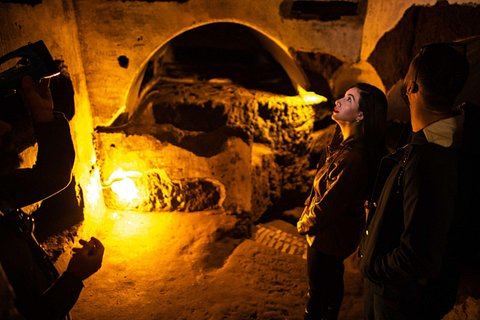 Rome Catacombs Night Tour with Santa Maria Maggiore After Hours
Free cancellation
(opens in a new tab)
-
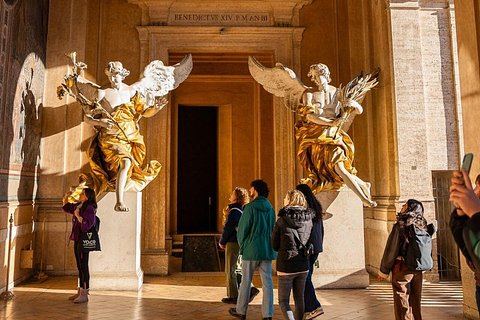 Private Jubilee Tour: 3 Papal Basilicas with Santa Maria Maggiore
Free cancellationPrivate
(opens in a new tab)
-
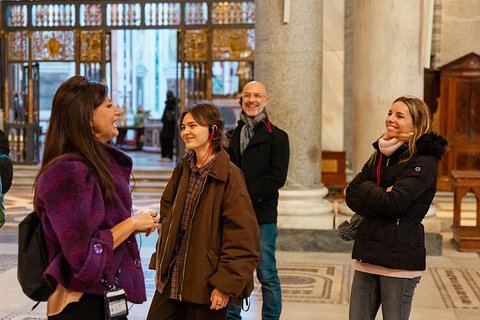 VIP After-hours Tour of Santa Maria Maggiore with Private Option
Free cancellation
(opens in a new tab)
Affiliate link Viator · If you book through this link, we may earn a commission at no extra cost to you.