
Written by  Maria Torres · Updated 2026-11-20
- Category
- Churches & Basilicas
- Area
- Centro Storico
Sant'Ignazio was built between 1626 and 1650 as the church of the Jesuits' Roman College, and dedicated to the order's founder, Ignatius of Loyola. Its showpiece is the ceiling fresco by the Jesuit painter Andrea Pozzo, from around 1685, which turns the barrel vault into an open sky with St. Ignatius being received into heaven. A marble disk in the middle of the nave floor marks the best viewing spot; a second marker farther on lines up Pozzo's painted dome, a flat canvas standing in for a cupola that was never built. Saints Aloysius Gonzaga and Robert Bellarmine are buried here. The small Rococo square in front, designed by Filippo Raguzzini, is worth a look on the way in.
Quick facts
- Address
- Via del Caravita 8/A, Pigna, 00186
- Admission
- Free
- Completed
- 1650
- Architect
- Orazio Grassi
The church of the Roman College
Sant'Ignazio di Loyola in Campo Marzio is the Jesuit church dedicated to St. Ignatius of Loyola, the Spanish founder of the Society of Jesus. It was built as the church of the Collegio Romano, the Jesuit college that Ignatius founded in 1551, whose building still adjoins it. Pope Gregory XV canonized Ignatius in 1622, and the pope's nephew, Cardinal Ludovico Ludovisi, paid for a new church to replace the college's small church of the Annunziata.
The foundation stone was laid on August 2, 1626. Several architects, Carlo Maderno among them, submitted plans, but the commission went to the Jesuit mathematician Orazio Grassi, a professor at the college. The church opened for worship for the Jubilee of 1650 and was consecrated in 1722. It is a Latin-cross church about 81.5 meters long, with six side chapels; the travertine façade is credited to Alessandro Algardi.
Andrea Pozzo's ceiling
The great attraction is the nave vault, painted around 1685 by Andrea Pozzo, a Jesuit lay brother and master of perspective. He painted architecture that continues the real walls upward, so that columns, arches and balconies seem to rise into an open sky. In the center, St. Ignatius is received into paradise among angels, surrounded by allegories of the four continents then known: Europe, Asia, Africa and America. St. Francis Xavier is shown guiding converts in Asia.
The illusion works from one place only. A disk set in the middle of the nave floor marks the spot; stand on it and look straight up, and the painted architecture lines up with the real building. Walk away from it and the columns start to lean and bend.
The dome that isn't there
Money ran out before a dome could be built over the crossing, so in 1685 Pozzo painted one on a flat canvas: a coffered cupola with a lantern, seen from below. A second floor marker, farther up the nave toward the altar, shows where to stand for the effect. The original canvas was lost in a fire, and the one you see today was painted in 1823 by Francesco Manno. Pozzo also painted the presbytery and apse between 1685 and 1701 with scenes from the life of St. Ignatius and the early history of the Jesuits, including the siege of Pamplona and his vision at La Storta.
Altars and tombs of three Jesuit saints
In the right transept, the altar of St. Aloysius Gonzaga, designed by Pozzo, has a marble high relief of the young saint's glory carved by Pierre Le Gros in 1697–1699; his remains lie in a lapis lazuli urn beneath it. The opposite altar in the left transept, the Ludovisi Chapel of the Annunciation, has a marble altarpiece by Filippo della Valle and holds the remains of St. John Berchmans. St. Robert Bellarmine, the Jesuit cardinal and theologian, is buried in the chapel of St. Joachim.
On the right of the presbytery is the monument to Pope Gregory XV and Cardinal Ludovisi, designed and largely carved by Le Gros around 1709–1714, with two flying figures of Fame by Pierre-Étienne Monnot.
Piazza di Sant'Ignazio
The small square in front of the church was laid out in 1727–1728 by Filippo Raguzzini. Its curving building fronts face the church façade like a stage set, and it is one of the best-known Rococo ensembles in Rome.
How to get there and tips
Sant'Ignazio is between the Pantheon and Via del Corso: from the Pantheon, walk east along Via del Seminario for about four minutes. The address is Via del Caravita 8/A. There is no metro station nearby; Barberini and Spagna on Metro A are each about 15 minutes' walk, and many ATAC buses run along Via del Corso, a short walk east. Santa Maria sopra Minerva is a three-minute walk south, and the Trevi Fountain (Fontana di Trevi) and the Galleria Doria Pamphilj are close by.
Entry is free; the Jesuits ask for voluntary donations, and volunteers from the Living Stones (Pietre Vive) initiative sometimes offer free explanations. Check the opening hours on the official site before you go and avoid Mass times. Allow 20–30 minutes, including time on both floor markers.
Frequently asked questions
Where do you stand to see the ceiling in Sant'Ignazio?
On the disk in the middle of the nave floor. A second marker farther toward the altar is the viewing point for Pozzo's painted dome.
Does Sant'Ignazio have a real dome?
No. Funds ran out before one was built, so Andrea Pozzo painted a dome on a flat canvas in 1685; the present canvas is an 1823 replacement by Francesco Manno.
Is Sant'Ignazio free to visit?
Yes. There is no entry fee, and donations are welcome.
Who is buried in Sant'Ignazio?
Three Jesuit saints: Aloysius Gonzaga, John Berchmans and Robert Bellarmine. The church also holds the monument to Pope Gregory XV and Cardinal Ludovico Ludovisi.
How far is Sant'Ignazio from the Pantheon?
About a four-minute walk east along Via del Seminario.
Popular tours that include Sant'Ignazio di Loyola
-
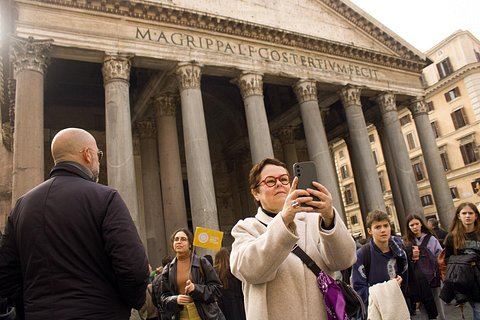 Rome Walking Tour: Pantheon, Trevi, Navona & Hidden Gems
Free cancellation
(opens in a new tab)
-
 Tour of Rome in Golf Cart: Rome in a Day
Free cancellationPrivate
(opens in a new tab)
-
 Rome: 90-Minute Private Vespa Sidecar Tour of Iconic Sights
Free cancellationPrivate
(opens in a new tab)
Affiliate link Viator · If you book through this link, we may earn a commission at no extra cost to you.