
Written by  Maria Torres · Updated 2026-11-20
- Category
- Piazzas & Fountains
- Area
- Centro Storico
Piazza Navona keeps the long oval of the Stadium of Domitian, begun in 80 AD, where ancient Romans came to watch the games. It became a Baroque showcase under Pope Innocent X (1644–1655), whose family palace, Palazzo Pamphili, faces the square. At the center is Gian Lorenzo Bernini's Fountain of the Four Rivers, unveiled on June 12, 1651: river gods for the Nile, Danube, Ganges and Río de la Plata sit on travertine rocks beneath a Roman obelisk topped by the Pamphili dove. Behind it rises the church of Sant'Agnese in Agone, and two fountains by Giacomo della Porta close the ends, the Neptune to the north and the Moor to the south, whose central figure Bernini added in 1673.
Quick facts
- Address
- Piazza Navona, Parione, 00186
- Admission
- Free
A square shaped by an ancient stadium
Piazza Navona has the long, round-ended shape of a racetrack because that is what it was. Emperor Domitian began a stadium here in 80 AD for Greek-style athletic contests, the agones, and the place became known as the Circus Agonalis; the modern name Navona is usually traced to a corruption of in agone. After the end of the western Empire the stands were quarried for stone, and houses and palaces were later built on what remained of them, which is why the buildings around the square still follow the curve of the old track.
Remains of the stadium survive about 4.5 meters below the present street level on the square's north side, with an entrance on Via di Tor Sanguigna. In the late 15th century the city market moved here from the Capitoline, and the square stayed a marketplace until 1869, when the market moved to Campo de' Fiori.
Bernini's Fountain of the Four Rivers
The centerpiece is Gian Lorenzo Bernini's Fontana dei Quattro Fiumi, commissioned by Pope Innocent X and built from 1648 to 1651. Four giant river gods, one for each continent then known, sit on a hollowed travertine rock: the Nile, carved by Giacomo Antonio Fancelli, has its head covered because its source was unknown; the Ganges, by Claude Poussin, holds an oar for a navigable river; the Danube, by Antonio Raggi, reaches toward a Pamphili coat of arms; and the Río de la Plata, by Francesco Baratta, holds a sack of silver coins, a play on the silvery color of its water. Giovan Maria Franchi carved the central rock, populated with a lion, a horse, a sea serpent, a dolphin and a creature that may be a crocodile or an armadillo.
Above the rock rises a Roman obelisk made in Domitian's time, found in 1647 in the Circus of Maxentius on the Appian Way, and topped with the bronze dove of the Pamphili family. The fountain was so expensive that the weight of the standard bread loaf was cut to pay for it, an unpopular measure many Romans blamed on the pope's sister-in-law, Olimpia Maidalchini.
A well-known story says the Río de la Plata raises his hand to shield himself from the collapse of the church by Bernini's rival, Francesco Borromini. It cannot be true: work on the church only started in 1652, the year after the fountain was finished.
Sant'Agnese in Agone and Palazzo Pamphili
Facing the fountain is Sant'Agnese in Agone, built on the place where tradition says Saint Agnes was martyred in the stadium. Construction began in 1652 under Girolamo Rainaldi and his son Carlo, and after many quarrels Borromini took over and gave it the concave façade between two bell towers that defines the west side of the square. Concerts of Baroque and chamber music are held in the Borromini Sacristy.
Next to the church stands Palazzo Pamphili, the family palace of Innocent X, now the Brazilian Embassy. Its long gallery, designed by Borromini, was frescoed by Pietro da Cortona. At the southern end of the square, Palazzo Braschi houses the Museo di Roma, the city museum covering Rome from the Middle Ages to the 19th century.
The fountains at either end
Giacomo della Porta designed both end fountains in the 1570s as simple basins. The Fontana del Moro at the south end dates from 1575; its central figure of a Moor, designed by Bernini, was added in 1673. The Fountain of Neptune at the north end, from 1574, stood without statues for three centuries until its statue of Neptune was added in 1878.
From 1652 until 1866 the square was flooded on weekends in August for the celebrations of the Pamphili family. The pavement was raised in the 19th century, which ended the custom.
The Christmas market
Every year from early December to early January the square fills with the stalls of the Christmas market, selling nativity figures, sweets and toys. It runs up to the feast of the Epiphany on January 6, the day of the Befana, the old woman who brings gifts to Italian children.
How to get there and nearby
Piazza Navona has no metro station. ATAC buses running along Corso Vittorio Emanuele II, including the 64 from Termini, stop at Corso Vittorio Emanuele/Navona, a short walk south of the square. From the Pantheon it is a walk of a few minutes west through the lanes past San Luigi dei Francesi, which holds three Caravaggio paintings of Saint Matthew.
Palazzo Altemps, part of the National Roman Museum, is just north of the square, and Campo de' Fiori lies across Corso Vittorio Emanuele II to the south. Early morning, before the café tables fill, is the best time to see the fountains without crowds; the square is pedestrian and free to enter at any hour.
What to see in Piazza Navona
The main monuments from north to south.
Fountain of Neptune
Where North end
Della Porta basin of 1574; Neptune and octopus added in 1878
Stadium of Domitian remains
Where Below street level, entrance on Via di Tor Sanguigna
Excavated parts of the 1st-century stadium
Fountain of the Four Rivers
Where Center
Bernini's fountain of 1648–1651 with Domitian's obelisk and the Pamphili dove
Sant'Agnese in Agone
Where West side, facing the central fountain
Church begun in 1652 by the Rainaldi, façade by Borromini
Palazzo Pamphili
Where West side, next to Sant'Agnese
Innocent X's family palace, now the Brazilian Embassy
Fontana del Moro
Where South end
Della Porta basin of 1575; Moor figure after Bernini added in 1673
Palazzo Braschi (Museo di Roma)
Where Southern end, toward Corso Vittorio Emanuele II
Museum of the city's history from the Middle Ages to the 19th century
The square is free and open at all times; check individual sites for opening hours.
Frequently asked questions
Why is Piazza Navona oval?
It follows the track of the Stadium of Domitian, begun in 80 AD; later buildings were raised on the ancient stands, keeping the stadium's shape.
Who made the fountain in the middle of Piazza Navona?
Gian Lorenzo Bernini designed the Fountain of the Four Rivers for Pope Innocent X, built from 1648 to 1651; the four river gods were carved by Fancelli, Poussin, Raggi and Baratta.
How do you get to Piazza Navona?
There is no metro stop; take an ATAC bus along Corso Vittorio Emanuele II, such as the 64 from Termini, to the Navona stop, or walk a few minutes from the Pantheon.
When is the Piazza Navona Christmas market?
It runs from early December to early January, ending with the Befana celebrations on January 6.
Can you see the ancient stadium under Piazza Navona?
Yes, the excavated remains lie about 4.5 meters below the street on the north side, with an entrance on Via di Tor Sanguigna; check its official site for opening times before you go.
Popular tours that include Piazza Navona
-
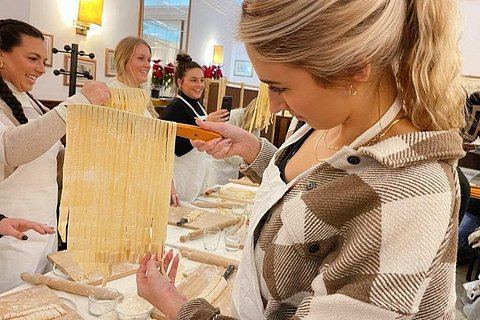 Pasta Cooking Class in Rome - Fettuccine Class in Piazza Navona
Free cancellation
(opens in a new tab)
-
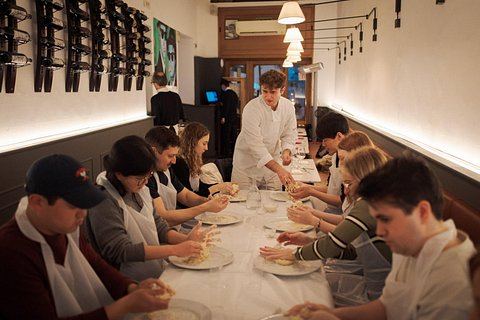 Pizza Cooking Class in Rome - Near Piazza Navona
Free cancellation
(opens in a new tab)
-
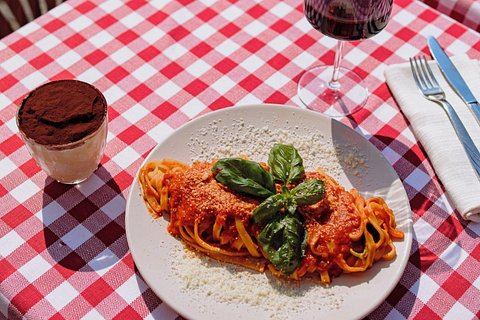 Pasta and Tiramisu Cooking Class in Rome, Piazza Navona
Free cancellation
(opens in a new tab)
Affiliate link Viator · If you book through this link, we may earn a commission at no extra cost to you.