
Written by  Maria Torres · Updated 2026-11-20
- Category
- Piazzas & Fountains
- Area
- Centro Storico
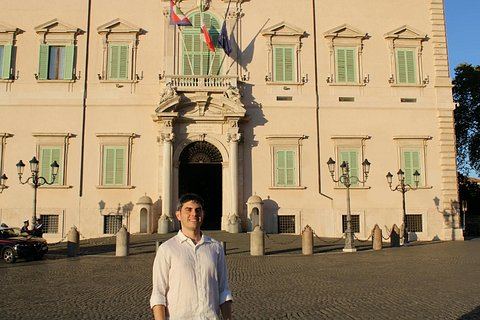
Piazza del Quirinale sits on top of the Quirinal, the highest of Rome's seven hills, and was known for centuries as Piazza di Monte Cavallo. Its northeast side is the façade of the Quirinal Palace, built from 1583 as a papal summer residence for Pope Gregory XIII, later home to the kings of Italy and, since 1946, the official residence of the President of the Republic. In the center, the Dioscuri Fountain groups imperial-era statues of Castor and Pollux with their horses, from the Baths of Constantine, around an obelisk from the Mausoleum of Augustus. The Palazzo della Consulta, seat of the Constitutional Court since 1955, closes the east side, and the Scuderie del Quirinale stages art exhibitions. On the west side, a balustrade overlooks the city.
Quick facts
- Address
- Piazza del Quirinale, Centro Storico, 00187
- Admission
- Free
Sources · facts checked on 2026-11-16
What the square is
Piazza del Quirinale occupies the top of the Quirinal, the highest of Rome's seven hills, between Via del Quirinale and Via XXIV Maggio. From the Middle Ages until the 19th century it was called Piazza di Monte Cavallo, Horse Hill, after the colossal horses of its marble statue group. Three official buildings frame it: the Quirinal Palace on the northeast side, the Palazzo della Consulta on the east and the Scuderie del Quirinale opposite the palace, while the west side ends in a balustrade looking out over the rooftops of the center.
The Dioscuri Fountain and obelisk
In the middle stand two marble groups of Castor and Pollux, the Dioscuri, each restraining a rearing horse. They are Roman copies of the 2nd–3rd century AD after Greek originals and came from the Baths of Constantine nearby. Domenico Fontana restored them and set them in front of the palace for Pope Sixtus V around 1587, when the new Acqua Felice aqueduct brought water up the hill.
Under Pope Pius VI, the architect Giovanni Antinori turned the two groups at an angle to each other in 1782 and raised between them a granite obelisk of about 15 meters. It had stood with its twin, now behind Santa Maria Maggiore, at the Mausoleum of Augustus, and was rediscovered in 1781. Work stopped when French troops occupied Rome in 1798, and Raffaele Stern completed the fountain in 1818 with a large granite basin found in 1587 in the Roman Forum, where it had been used as a cattle trough.
The Quirinal Palace
Pope Gregory XIII began the palace in 1583 as a summer residence, on plans by Ottaviano Mascherino; Domenico Fontana designed the long façade on the square and Carlo Maderno the Great Chapel. Popes lived and held four conclaves here until 1870, and after Rome became the capital of Italy in 1871 it was the royal palace. Since 1946 it has been the official residence of the President of the Republic. It covers about 110,500 square meters with some 1,200 rooms and has gardens of about 4 hectares.
Guided visits run on several days a week, with three routes of about 1 hour 20 minutes: the state rooms and Imperial Apartments, a route through the porcelain, gardens and carriages, and the Quirinale Contemporaneo route with modern Italian art and design. Booking in advance on the official site is compulsory, last entry is at 14:30, and the palace closes for Republic Day on 2 June, at Christmas and in August; check the visiting days on the official site before you go.
The changing of the guard
Every Sunday the Corazzieri, the mounted Carabinieri regiment that guards the President, change the guard in front of the palace gate, accompanied by the band of the Guardia di Finanza. Larger ceremonial versions take place on national anniversaries such as 2 June. Times can vary, so check before you go.
Around the square
The Palazzo della Consulta, built for the papal court of the Consulta, later the Ministry of Italian Africa, has been the seat of the Constitutional Court since 1955. The Scuderie del Quirinale, the 18th-century papal stables by Alessandro Specchi and Ferdinando Fuga, were restored in 1997–1999 and now hold major art exhibitions; in November 2026 the show was Pontormo, running to 7 February 2027.
From the balustrade on the west side you look across the center toward the dome of St. Peter's Basilica (Basilica di San Pietro). A flight of steps beside it leads down to Via della Dataria.
How to get there and tips
The square is a steep walk from the center. From the Trevi Fountain (Fontana di Trevi), take Via della Dataria and the steps up to the balustrade, a few minutes' climb. From Metro A Barberini, walk up Via delle Quattro Fontane and turn right onto Via del Quirinale, passing Palazzo Barberini (National Gallery of Ancient Art) on the way. ATAC buses run along Via Nazionale below the hill.
Pair the square with the Trevi Fountain below or with Santa Maria della Vittoria and Palazzo Barberini to the northeast. Sunday is the day to come if you want to see the guard change.
Frequently asked questions
Can you visit the Quirinal Palace?
Yes, on guided tours of about 1 hour 20 minutes on several days a week. Booking on the official site is compulsory, and the palace closes in August, at Christmas and for 2 June.
When is the changing of the guard at the Quirinale?
Every Sunday in front of the palace, performed by the Corazzieri with the Guardia di Finanza band. Check the time before you go.
How do I get from the Trevi Fountain to Piazza del Quirinale?
Walk up Via della Dataria and the steps at its end, which come out at the balustrade on the west side of the square, a few minutes' climb.
Who are the statues in Piazza del Quirinale?
Castor and Pollux, the Dioscuri, with their horses: Roman copies of Greek originals from the Baths of Constantine, set around an obelisk from the Mausoleum of Augustus.
Who lives in the Quirinal Palace?
It has been the official residence of the President of the Italian Republic since 1946; before that it housed the popes and then the kings of Italy.
Popular tours that include Piazza del Quirinale
Affiliate link Viator · If you book through this link, we may earn a commission at no extra cost to you.