
Written by  Maria Torres · Updated 2026-11-20
- Category
- Food & Markets
- Area
- Centro Storico
The produce market in Campo de' Fiori has been held in the square since 1869, when it moved here from Piazza Navona, and its wooden stalls still go up every morning except Sunday. Vendors sell flowers, fruit and vegetables, meat and fish around the hooded bronze statue of Giordano Bruno by Ettore Ferrari, unveiled in 1889 on the spot where the philosopher was burned for heresy on February 17, 1600. The fountain at the edge of the square dates from 1898 and copies Giacomo Della Porta's lidded basin, nicknamed the Terrina, which stallholders once used to keep produce cool. Come in the morning: by evening the market is gone and the square belongs to restaurant terraces.
Quick facts
- Address
- Piazza Campo de' Fiori, Centro Storico, 00186
- Metro / train
- Tram 8 · Arenula/Cairoli (~5 min walk)
The morning market
Every morning from Monday to Saturday, rows of stalls under white umbrellas fill Campo de' Fiori, one of the few squares in the historic center with no church on it. Vendors sell fruit and vegetables, flowers, meat, chicken and fish, cheese and cured meats, dried pulses, rice and dried fruit. By afternoon the stalls are packed away, the square is swept, and the restaurant and bar terraces around the edge take over.
The square has been a trading place for country produce since at least the 19th century, and the market still follows the old pattern of a morning sale that disappears by lunchtime. Because it is in the middle of the historic center, it draws as many visitors as local shoppers.
From flowered meadow to marketplace
Campo de' Fiori, the field of flowers, was open ground until the 15th century, when the area between the ruins of Pompey's Theatre and the Tiber was built up. In 1456 Pope Callixtus III had it paved, and inns for pilgrims grew up around it. A horse market was held here twice a week, on Mondays and Saturdays, and the surrounding streets still carry the names of the trades that worked them: Via dei Cappellari (hat-makers), Via dei Giubbonari (makers of jackets) and Via dei Baullari (trunk-makers).
The square reached its present size after a block of houses on its north side was demolished in 1858. In 1869 the daily food market moved here from Piazza Navona, and the vignarole, women who brought herbs and vegetables in from the countryside, became part of the scene. The market's everyday life is the subject of the 1943 film Campo de' fiori, starring Anna Magnani and Aldo Fabrizi.
The Giordano Bruno monument
The hooded bronze figure in the middle of the square is the philosopher and former Dominican friar Giordano Bruno, burned alive for heresy on this spot on February 17, 1600. The statue by Ettore Ferrari was unveiled on June 9, 1889, after a campaign begun by a students' committee in 1876 and backed by figures such as Victor Hugo, Ernest Renan, Henrik Ibsen and Walt Whitman, against strong opposition from the Church. Bruno faces toward the Vatican.
The granite pedestal carries bronze reliefs of scenes from his life and medallions of other thinkers persecuted for their ideas. The inscription reads 'A Bruno il secolo da lui divinato qui dove il rogo arse': to Bruno, from the century he foresaw, here where the pyre burned.
The Terrina fountain
At the north edge of the square stands a basin copying the Fontana della Terrina, which Giacomo Della Porta built for the center of Campo de' Fiori in 1590. Stallholders used the original to keep produce cool and wash vegetables, and dumped market waste in it despite papal edicts. In 1622 the basin was covered with a travertine lid that made it look like a soup tureen, terrina in Italian, and an inscription around the knob reads 'Ama Dio e non fallire, fa del bene e lassa dire': love God and do no wrong, do good and let them talk.
The original fountain was removed when the square was rearranged for the Bruno monument, spent years in municipal storage and was later set up in front of the Chiesa Nuova on Corso Vittorio Emanuele II. The copy in Campo de' Fiori reproduces Della Porta's basin without the lid.
Getting there
There is no Metro station nearby. Tram 8 stops at Arenula/Cairoli on Via Arenula, a short walk from the square, and many ATAC buses, including the 40 and 64 from Roma Termini, stop at Largo di Torre Argentina or along Corso Vittorio Emanuele II, about 5 to 10 minutes away on foot. Piazza Navona is about 5 minutes north through the lanes.
Tips for your visit
Come in the morning, ideally before mid-morning, when the market is at its fullest and the square is less crowded. Allow 20 to 30 minutes for the stalls, then walk one block southwest to Palazzo Farnese, now the French Embassy, or northwest to Palazzo della Cancelleria.
In the evening Campo de' Fiori is a busy meeting place for drinks and dinner, especially for students and young visitors. The square fits easily into a walk with Piazza Navona, Largo di Torre Argentina and the Jewish Ghetto, all within 10 minutes.
Frequently asked questions
What days is the Campo de' Fiori market open?
The market is held every morning from Monday to Saturday and does not run on Sundays. By afternoon the stalls are gone.
Is Campo de' Fiori market worth visiting?
It is worth a short stop in the morning for the produce and flower stalls, the Giordano Bruno statue and the square's history. It combines easily with Piazza Navona, a few minutes away.
How do I get to Campo de' Fiori?
Take tram 8 to Arenula/Cairoli or a bus such as the 40 or 64 to Largo di Torre Argentina, then walk 5 to 10 minutes. There is no Metro station nearby.
Who is the statue in Campo de' Fiori?
It is Giordano Bruno, the philosopher burned for heresy in the square on February 17, 1600. Ettore Ferrari's statue was unveiled on June 9, 1889.
Since when has there been a market in Campo de' Fiori?
The daily food market moved here from Piazza Navona in 1869; before that the square held a twice-weekly horse market.
Popular tours that include Campo de' Fiori Market
-
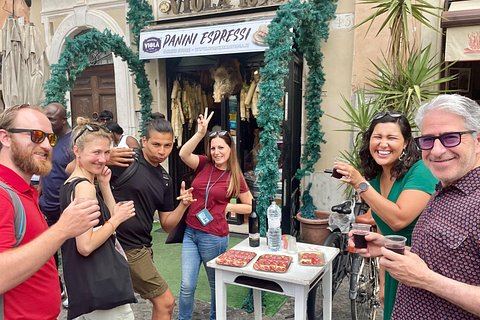 Tasty Rome Street Food Tour around Campo de' Fiori Market & Jewish Ghetto
Free cancellation
(opens in a new tab)
-
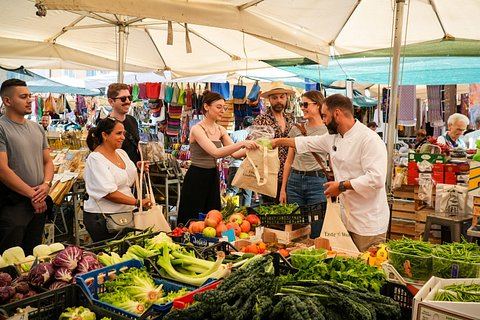 Farmer's Market Pasta And Tiramisu Masterclass with Italian Wine
Free cancellation
(opens in a new tab)
-
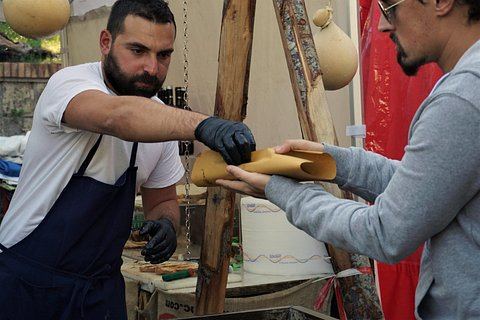 ROME FOOD TOUR: 8 Tastings | Mini-Group of 8 People
Free cancellation
(opens in a new tab)
Affiliate link Viator · If you book through this link, we may earn a commission at no extra cost to you.