
Written by  Maria Torres · Updated 2026-11-20
- Category
- Ancient Rome
- Area
- Centro Storico
Demolitions for new buildings begun in 1926 uncovered this sunken square of four Republican temples, opened to the public in 1929 and still labeled A to D because their dedications are not certain; the oldest, Temple C, dates to the early 3rd century BC. Part of the Theatre of Pompey lies here too, and the spot where Julius Caesar is believed to have been killed, in the Curia of Pompey, is within the square. Since June 2023 a walkway lets visitors move among the ruins, with displays of finds and a lift platform for wheelchair users; a visit takes about 45 minutes. The ruins are also visible from the street, and Temple D is home to a cat sanctuary founded in 1993.
Quick facts
- Address
- Via di San Nicola de' Cesarini, Centro Storico, 00186
- Admission
- Paid (ticketed)
What you see at Largo Argentina
Largo di Torre Argentina is a busy traffic square in the Centro Storico with a sunken archaeological area in the middle, the Area Sacra (sacred area). Below street level stand the remains of four temples from the Roman Republic, set side by side on a shared paved square and labeled A, B, C and D because their dedications are not certain. Behind them lie remains of the Curia of Pompey and part of the complex of the Theatre of Pompey, and on the corner rises the medieval Torre del Papito.
The name has nothing to do with Argentina the country. It comes from a tower in the house of Johannes Burckardt, a papal master of ceremonies from Strasbourg, whose Latin name was Argentoratum; Burckardt called himself Argentinus, and his tower became the Torre Argentina.
The four temples
Temple C is the oldest, built between the late 4th and early 3rd century BC and probably dedicated to Feronia, a goddess whose cult came from the Sabine country. Temple A dates to the mid-3rd century BC and is often linked to Juturna; in the Middle Ages the church of San Nicola de' Calcarari was built into it. Temple D, the largest, dates to the early 2nd century BC and is attributed to the Lares Permarini, guardian spirits of seafarers, though some scholars propose the Nymphs.
Temple B is the only round one, a ring of columns on a high podium, six of which still stand. Most scholars identify it as the Temple of Fortuna Huiusce Diei, the "Fortune of This Day", vowed by Quintus Lutatius Catulus for the victory over the Cimbri in 101 BC. Fragments of its huge cult statue, of which the marble head and arms survive, are now displayed at the Centrale Montemartini museum.
Where Caesar was killed
Behind Temples B and C is a large tuff platform that belonged to the Curia of Pompey, a hall attached to the Theatre of Pompey where the Senate was meeting on the Ides of March, March 15, 44 BC. Julius Caesar was stabbed to death there. The site is within the archaeological area, and a backlit image of Caesar now marks the spot.
Excavation and the 2023 walkway
The area came to light in 1926 during demolitions for a new building plan; excavation continued until 1928, with later campaigns into the 1970s. In 1927 workers found the colossal marble head and arms of the Temple B statue. For almost a century the ruins could only be seen from the railings above.
On June 20, 2023 the site opened to visitors on a walkway at the level of the temples, built with funding from the jeweler Bulgari under the scientific direction of the Sovrintendenza Capitolina. The route has no architectural barriers, with a lift platform for wheelchair users and strollers, tactile panels in Italian, English and Braille, and two small displays: one in the portico of the Torre del Papito and one in rooms below Via di San Nicola de' Cesarini. Finds include inscriptions, sarcophagi, architectural fragments and two heads from colossal cult statues.
The cat sanctuary
Rome's best-known colony of street cats lives among the ruins. The Torre Argentina Cat Sanctuary, founded in 1993 and run by volunteers from a space in Temple D, cares for the cats as a no-kill shelter, and the cats move freely among the ruins. Its presence inside an archaeological site has been disputed by archaeologists over the years.
Tickets, hours and getting there
Entry is from Via di San Nicola de' Cesarini, opposite number 10; the ticket office and bookshop are in the Torre del Papito on Piazza dei Calcarari. Entry is timed every 20 minutes, booking in advance is required (up to five tickets per booking), and the visit takes about 45 minutes. There are no toilets on site.
When last checked (November 2026), the city tourism site listed opening Tuesday to Sunday, 9:30 to 16:00 in winter and 9:30 to 19:00 from late March to late October, closed Mondays, January 1, May 1 and December 25. Full tickets were €5 for non-residents and €4 for Rome residents, with a €1 booking fee, and MIC card holders enter free. Check the official site before you go. You can also see the whole area for free from the railings around the square.
The Pantheon is a few minutes' walk north, and Campo de' Fiori, the Church of the Gesù (Chiesa del Gesù) and the Turtle Fountain (Fontana delle Tartarughe) in the Jewish Ghetto are all within about ten minutes on foot. Tram 8 from Trastevere ends at Piazza Venezia, a short walk east.
Frequently asked questions
Can you go inside Largo di Torre Argentina?
Yes. Since June 20, 2023 a barrier-free walkway lets visitors walk among the temples with a timed, pre-booked ticket; the ruins are also visible for free from street level.
Is Largo Argentina where Julius Caesar was killed?
Yes. Caesar was stabbed on March 15, 44 BC in the Curia of Pompey, whose tuff platform survives behind Temples B and C inside the archaeological area.
How long does a visit to Largo di Torre Argentina take?
The walkway visit takes about 45 minutes, with entries every 20 minutes.
How much does it cost to visit Largo Argentina?
When checked in November 2026, a full ticket was €5 for non-residents and €4 for Rome residents, plus a €1 booking fee; check the official site before you go.
Why are there cats at Largo di Torre Argentina?
A volunteer-run sanctuary founded in 1993 cares for a colony of street cats from a space in Temple D, and the cats roam freely among the ruins.
Why is it called Torre Argentina?
It is named after a tower built by Johannes Burckardt, a papal official from Strasbourg, whose Latin name was Argentoratum.
Popular tours that include Largo di Torre Argentina
-
 PRIVATE Rome Kickstart Tour With a Local PRIVATE Guide
Free cancellationPrivate
(opens in a new tab)
-
 Rome: Golf Cart Panoramic City Tour
Free cancellation
(opens in a new tab)
-
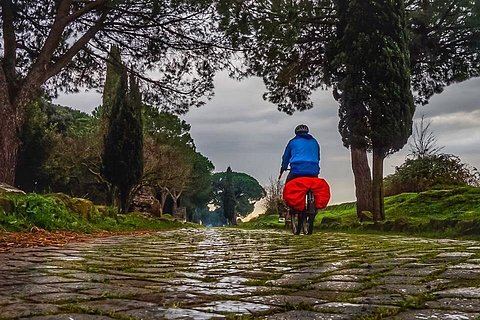 Ancient Appian Way and Roman Countryside E-Bike Tour
Free cancellation
(opens in a new tab)
Affiliate link Viator · If you book through this link, we may earn a commission at no extra cost to you.