
Written by  Maria Torres · Updated 2026-11-20
- Category
- Ancient Rome
Emperor Caracalla inaugurated these baths in AD 216, and the complex kept working until 537, when the Goth king Vitiges cut Rome's aqueducts during his siege of the city. Because nothing was later built on top, it is one of the best-preserved imperial buildings, and the brick walls of the caldarium, frigidarium and two gymnasiums still stand to great height, with patches of mosaic floor. Below run about two kilometers of service tunnels and one of the largest Mithraea in Rome. The Rome Opera has held summer seasons here since 1937, now on a stage outside the ruins, and the first Three Tenors concert took place here in 1990. Tickets are name-based and sold through the official Musei Italiani portal or on site.
Quick facts
- Address
- Viale delle Terme di Caracalla 52, Aventino
- Metro / train
- Metro B B · Circo Massimo
- Admission
- Paid (ticketed)
What the Baths of Caracalla are
The Baths of Caracalla were a public bath complex built probably between AD 212 (or 211) and 216 under Septimius Severus and his son Caracalla, who inaugurated the central building in 216. Decoration continued under Elagabalus and Severus Alexander, and the complex was probably largely finished by 235. Entry was free. Only the later Baths of Diocletian (Terme di Diocleziano) were larger.
The whole precinct measures 337 by 328 meters (about 1,105 by 1,076 feet), and the main bath building alone 214 by 110 meters (702 by 361 feet). The historian Olympiodorus of Thebes gave a capacity of 1,600, probably bathers present at one time; modern estimates put daily use at 6,000 to 8,000 people.
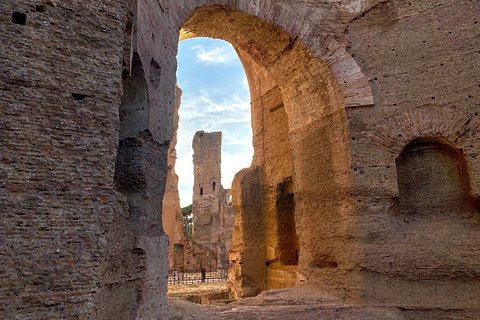
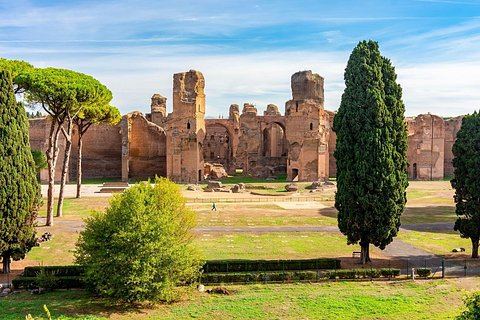
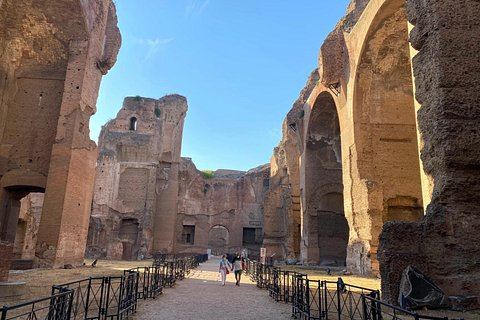
The baths worked until 537, when the Gothic king Vitiges cut Rome's aqueducts during his siege of the city. Because nothing was later built over them, the walls of the main halls still stand to great height.
What you see: the bathing halls
The main building was laid out symmetrically around a central axis of three great rooms. The caldarium, the hot room, was a circular hall about 35 meters (115 feet) across under a dome almost as wide. The frigidarium, the cold hall, measured about 58 by 24 meters, and beyond it the natatio, an open-air swimming pool, about 50 by 22 meters. A tepidarium (warm room) sat between them, and two palaestrae, colonnaded courtyards for exercise, flanked the sides.
Walking through, you see the brick walls of these halls rising to great height, with surviving patches of mosaic floor. In 2024 a contemporary water installation called Specchio (Mirror) was inaugurated in the complex and is used for shows, concerts and cultural events.
The Domus di Vigna Guidi, a Roman house found under the baths, has frescoes that were restored and reopened in 2022. It closes on very crowded days, such as the first Sunday of the month.
The underground: tunnels and the Mithraeum
Beneath the baths runs a network of service galleries about two kilometers (1.2 miles) long, which held the furnaces, water channels and mills that kept the complex running.
One of the underground rooms became a Mithraeum, a sanctuary of the god Mithras, discovered in 1912. At about 23 by 10 meters it is one of the largest preserved in Rome, and it still has a fossa sanguinis, a pit associated with the cult's blood rituals. The Mithraeum opens only during events or special guided visits.
The Farnese sculptures and the athlete mosaics
The baths were richly decorated, and excavations recovered colossal statues that ended up in the Farnese collections, among them the Farnese Bull and the Farnese Hercules, both now in Naples. Floor mosaics of athletes found in 1824 are in the Vatican Museums (Musei Vaticani).
Opera, Olympics and the Three Tenors
From 1937 to 1993 the caldarium was the summer stage of the Rome Opera. Performances returned in 2001 on a movable stage that no longer stands inside the ancient halls. The baths hosted the gymnastics events of the 1960 Rome Olympics, and in 1990 the first Three Tenors concert, with José Carreras, Plácido Domingo and Luciano Pavarotti, took place here.
In summer 2026 the site also ran Notturno Imperiale, evening openings on selected dates between July and mid-October, limited to 1,200 visitors per evening and sold online only, at €8 full price and €2 reduced.
Hours, tickets and getting there
When this page was checked (November 2026), Turismo Roma listed the baths as open Tuesday to Sunday and closed on Mondays, with seasonal hours: 9:00 to 16:30 from 26 October to 28 February (last entry 15:30); 9:00 to 17:30 in March; 9:00 to 19:15 from 29 March to 31 August; 9:00 to 19:00 in September; and 9:00 to 18:30 from 1 to 25 October, with last entry 60 to 75 minutes before closing. Tickets are sold online and through the Ministry of Culture's Musei Italiani app with no booking fee, and the entrance kiosks take card payments only. Visitors under 18 enter free. The official listing gave more than one full price, so check the official site before you go.
The entrance is on Viale delle Terme di Caracalla. The nearest metro is Circo Massimo on Metro B; from the station, walk south along Viale delle Terme di Caracalla, past the eastern end of the Circus Maximus (Circo Massimo).
Tips for your visit
Plan on one and a half to two hours to walk the halls and gardens; the site is large and mostly open to the sky, so bring water and sun protection in summer. The underground Mithraeum and some of the galleries open only on special visits, so check what is open on the day.
The baths fit naturally into a southbound itinerary: the Circus Maximus and the Aventine gardens lie just north, and Via di Porta San Sebastiano continues south toward the Appian Way Regional Park (Parco dell'Appia Antica) and the catacombs.
Frequently asked questions
Are the Baths of Caracalla worth visiting?
Yes, for the scale of the surviving halls: the walls of the caldarium, frigidarium and gymnasiums still stand to great height, with mosaic floors and fallen marble around them.
How long do you need at the Baths of Caracalla?
About one and a half to two hours to walk the main halls, gymnasiums and gardens; more if you join a special visit to the underground.
What are the opening hours of the Baths of Caracalla?
When last checked (November 2026), the baths opened Tuesday to Sunday from 9:00, closing between 16:30 in winter and 19:15 in summer, and were closed on Mondays. Check the official site before you go.
How do I get to the Baths of Caracalla?
Take Metro B to Circo Massimo and walk south along Viale delle Terme di Caracalla to the entrance.
How many people could use the Baths of Caracalla?
About 1,600 bathers at once, with an estimated 6,000 to 8,000 people a day.
Can you visit the Mithraeum of the Baths of Caracalla?
Only during events or special guided visits; it is not part of the regular route.
Popular tours that include Baths of Caracalla (Terme di Caracalla)
-
 Rome: Semiprivate or Group Tour Caracalla Baths & Circus Maximus
Free cancellation
(opens in a new tab)
-
 Small group Tour: Caracalla Roman baths
Free cancellation
(opens in a new tab)
-
 Private Tour of Caracalla Baths and Circus Maximus
Free cancellationPrivate
(opens in a new tab)
Affiliate link Viator · If you book through this link, we may earn a commission at no extra cost to you.