
Written by  Maria Torres · Updated 2026-11-20
- Category
- Catacombs & Underground Rome
Built in just eight years between AD 298 and 306, the Baths of Diocletian covered 13 hectares between the Viminal and Quirinal hills and could hold up to 3,000 people at once. Maximian began the work and dedicated it to his co-emperor Diocletian, and the baths ran until the Gothic War of the 6th century cut the aqueducts. In 1561 Pope Pius IV gave the ruins to Michelangelo, who turned the great cold-water hall into the basilica of Santa Maria degli Angeli and laid out a Carthusian monastery around a large cloister. That cloister and the surviving halls are now a seat of the National Roman Museum, holding its inscriptions and protohistoric collections. Palazzo Massimo is nearby, close to Termini station.
Quick facts
- Address
- Via Enrico de Nicola 78, Esquilino & Termini, 00185
- Opening hours
- Tue–Sun: 09:00–19:00
- Admission
- Paid (ticketed)
Sources · facts checked on 2026-11-16
- Ministero della Cultura – Museo Nazionale Romano, Terme di Diocleziano
- Museo Nazionale Romano – Terme di Diocleziano
- Turismo Roma – Museo Nazionale Romano, Baths of Diocletian
- Terme di Diocleziano (Italian Wikipedia)
- Baths of Diocletian (English Wikipedia)
- Turismo Roma – Santa Maria degli Angeli e dei Martiri
- Repubblica (metropolitana di Roma) (Italian Wikipedia)
What the Baths of Diocletian are
The Baths of Diocletian were the largest bath complex ever built in Rome. Covering about 13 hectares between the Viminal and Quirinal hills, they could take up to 3,000 people at once. Today the remains are split between three uses: the church of Santa Maria degli Angeli e dei Martiri, built inside the central halls; Piazza della Repubblica, whose curved porticoes by Gaetano Koch follow the outline of the baths' great exedra; and a seat of the National Roman Museum (Museo Nazionale Romano), which has occupied the former Carthusian monastery and the surviving halls since the museum was founded in 1889.
The museum entrance is at Via Enrico de Nicola 78, in the garden facing Piazza dei Cinquecento and Roma Termini station.
History: from Roman baths to monastery and museum
Maximian, ruling the West, began the baths in 298 and dedicated them to his co-emperor Diocletian; they were inaugurated in 305–306, just after the two emperors had abdicated. An inscription that hung at the entrance credited Maximian with building the baths for the citizens. Water came from a branch of the Aqua Marcia ending in a cistern more than 90 meters long, the botte di Termini, demolished in 1876 for the railway station. The layout followed the Baths of Trajan, with the calidarium (hot room), tepidarium (warm room) and frigidarium (cold room) on a central axis, flanked by palaestrae and an open-air pool, the natatio, of about 4,000 square meters. The baths ran until 537, when the Goths of Vitiges cut the aqueducts during the Gothic War.
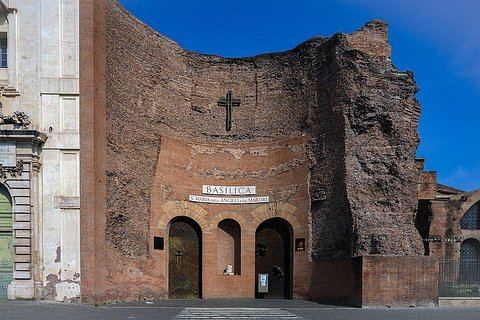
In the 1560s Pope Pius IV commissioned Michelangelo to turn the central hall into a church, Santa Maria degli Angeli, and to design a Carthusian monastery in the surrounding rooms; the first monastery building was finished in 1564. In 1749 Luigi Vanvitelli turned the church by 90 degrees and opened the present entrance in a former apse of the calidarium. From 1575 several halls were used as grain and oil stores, and the Carthusians left in 1884.
What you see in the museum
The visit begins in the large cloister of the Certosa, designed by Michelangelo and one of the largest in Italy, at about 10,000 square meters. Along its four porticoes stand statues, sarcophagi, altars and reliefs, grouped by where in Rome they were found. A small cloister was built next to it in the same years. In the entrance garden, funerary steles from the late Republic to the early Empire and altars of the first two centuries AD show how ordinary Romans were commemorated.
The epigraphic museum, presented as the museum of the Romans' written communication, traces the birth and spread of Latin writing through inscriptions from the collections; among the museum's funerary pieces is the stele of the cook Eros, slave of Posidippus. The museum of the protohistory of the Latin peoples covers the region before and around the founding of Rome. Some of the ancient bath halls are also part of the route, and the Octagonal Hall (Aula Ottagona), which served as Rome's planetarium from 1928 to 1983, now houses the Museo dell'Arte Salvata, devoted to recovered works of art.
Hours and tickets
When checked in November 2026, the Ministry of Culture listed the Baths of Diocletian as open Tuesday to Sunday 9:00–19:00, with the ticket office closing at 18:00, and closed on Mondays. A full ticket was €15 and a reduced one €2; single tickets allow one entry per site of the National Roman Museum and are valid for a week from first use, so the same ticket covers Palazzo Massimo alle Terme (National Roman Museum) and Palazzo Altemps. An annual MNR Card cost €30 (€20 reduced). Booking was optional. In November 2026 some halls (Aula X, XI and XI bis, and the Octagonal Hall) were closed for temporary exhibitions; check museonazionaleromano.it before you go.
How to get there and nearby
The baths are directly across Piazza dei Cinquecento from Roma Termini, the hub of Metro A and Metro B, the Leonardo Express from Fiumicino and many ATAC buses. Metro A Repubblica, in Piazza della Repubblica, is next to Santa Maria degli Angeli.
Palazzo Massimo alle Terme (National Roman Museum) is a short walk across the piazza, and Santa Maria Maggiore is within walking distance to the south. Mercato Centrale Roma, inside Termini, is the closest place for a sit-down meal before or after.
What to see at the Baths of Diocletian
The main parts of the museum site and the church built into the baths.
Michelangelo's cloister
Where Center of the museum
Great Carthusian cloister of about 10,000 m² lined with statues and sarcophagi
Entrance garden
Where Facing Piazza dei Cinquecento
Funerary steles, altars and architectural fragments
Epigraphic museum
Where Modern galleries
Latin inscriptions tracing Roman written communication
Protohistory of the Latin peoples
Where Upper floor of the cloister
Finds from Latium before and around the founding of Rome
Octagonal Hall
Where Corner of Via Parigi
Ancient bath hall, planetarium 1928–1983, now the Museo dell'Arte Salvata
Santa Maria degli Angeli e dei Martiri
Where Piazza della Repubblica
Church fitted by Michelangelo into the frigidarium; entrance by Vanvitelli in a calidarium apse
Halls can close for temporary exhibitions; the church is reached from Piazza della Repubblica.
Frequently asked questions
Are the Baths of Diocletian worth visiting?
Yes, if you want to see the scale of a Roman bath complex and Michelangelo's cloister, plus large collections of inscriptions; the ticket also covers Palazzo Massimo and Palazzo Altemps for a week.
What are the Baths of Diocletian opening hours?
When checked in November 2026: Tuesday to Sunday 9:00–19:00, ticket office until 18:00, closed Mondays. Check museonazionaleromano.it before you go.
How much is the ticket for the Baths of Diocletian?
In November 2026 a full ticket was €15 and a reduced one €2, valid for one entry to each National Roman Museum site within a week.
How do I get to the Baths of Diocletian?
Walk across Piazza dei Cinquecento from Roma Termini, or take Metro A to Repubblica.
Who designed Santa Maria degli Angeli?
Michelangelo, commissioned by Pope Pius IV in the 1560s; Luigi Vanvitelli reoriented the church in 1749.
Popular tours that include Baths of Diocletian (Terme di Diocleziano)
-
 Ancient Roman Baths & Michelangelo’s Renaissance Basilica in Rome
Free cancellation
(opens in a new tab)
-
 Rome: a journey into Roman times, Half-Day Semi-Private Tour
Free cancellation
(opens in a new tab)
Affiliate link Viator · If you book through this link, we may earn a commission at no extra cost to you.