
Written by  Maria Torres · Updated 2026-11-20
- Category
- Catacombs & Underground Rome
In the 3rd century this was the official cemetery of the Church of Rome, named after the deacon Callixtus, whom Pope Zephyrinus put in charge of it. Around half a million Christians were buried here, including dozens of martyrs and sixteen popes. The galleries descend five levels and run for roughly 20 kilometers, and they were rediscovered in 1854 by the archaeologist Giovanni Battista de Rossi. Guided tours cover the Crypt of the Popes, the crypt of Saint Cecilia and the Cubicles of the Sacraments. The Salesians of Don Bosco have run visits since 1930, booking online is required, and the site closes for several weeks each winter.
Quick facts
- Address
- Via Appia Antica 110, Appia Antica & South Rome, 00179
- Admission
- Paid (ticketed)
Official website → Open in OpenStreetMap →
Sources · facts checked on 2026-11-16
- Catacombs of St. Callixtus – official site
- Catacombs of St. Callixtus – Hours
- Catacombs of St. Callixtus – Tickets
- Catacombs of St. Callixtus – Directions
- Catacombs of St. Callixtus – Guidelines
- Catacombs of St. Callixtus – Routes
- Catacombs of St. Callixtus – Crypt of the Popes
- Catacombs of St. Callixtus – Crypt of St. Cecilia
What the Catacombs of San Callisto are
The Catacombs of San Callisto are an underground Christian cemetery on the Appian Way, entered from Via Appia Antica 110, between the Quo Vadis church and the Basilica of San Sebastiano. In the 3rd century they were the official cemetery of the Church of Rome. About half a million Christians were buried here, among them many martyrs and 16 popes.
The galleries go down five levels and run for roughly 20 kilometers. The catacomb itself takes up about 15 hectares, inside a wider funerary complex of about 30 hectares that stretches between Via Appia Antica, Via Ardeatina and Via delle Sette Chiese. The site belongs to the Holy See: its preservation is the responsibility of the Pontifical Commission of Sacred Archaeology, and the Salesians of Don Bosco have run reception and guided tours since 1930.
History: from private tombs to the popes' cemetery
Christian community cemeteries began here in the second half of the 2nd century, when wealthy converted families gave land to the Church. At the beginning of the 3rd century Pope Zephyrinus put the deacon Callixtus in charge of the cemetery; Callixtus later became pope himself and enlarged it, and the catacomb still carries his name. The oldest areas are the Crypts of Lucina and the area of the Popes and Saint Cecilia, followed by the area of Pope Miltiades (mid-3rd century), the area of Saints Gaius and Eusebius (late 3rd century), the Western Area (first half of the 4th century) and the Liberian Area (second half of the 4th century).
The archaeologist Giovanni Battista de Rossi began excavating in 1849 and in 1854 found the Crypt of the Popes. Near it he identified the tomb of Pope Cornelius, marked with the inscription CORNELIVS MARTYR. Human remains have since been removed from the excavated areas, so the niches you see along the galleries are empty.
What you see on the tour
At the entrance stand two small three-apsed basilicas known as the Trichorae; the eastern one may have held the burials of Pope Zephyrinus and of Saint Tarcisius, a young martyr of the Eucharist. Underground, the route reaches the Crypt of the Popes, nicknamed the little Vatican because it was the official burial place of nine popes and probably eight other dignitaries of the 3rd-century Church. The original Greek tombstones of five popes, Pontianus, Anterus, Fabian, Lucius and Eutychian, are still in the walls, and Pope Sixtus II, killed in Emperor Valerian's persecution, was laid in the front wall.
Next door, the Crypt of Saint Cecilia marks where the patron saint of music was entombed after her martyrdom in the 3rd century; she was venerated here for at least five centuries until her relics were moved in 821 to her basilica in Trastevere. A statue in the crypt copies the one Stefano Maderno carved in 1599, and early 9th-century paintings show Cecilia praying, Christ holding a Gospel and Saint Urban.
The Cubicles of the Sacraments, painted in the first half of the 3rd century, carry images that refer to baptism, the Eucharist and the resurrection, while elsewhere in the cemetery a painting shows two fish carrying a basket of bread, another Eucharistic symbol. Depending on the route, tours also pass through the area of Pope Miltiades and the Crypt of Saints Gaius and Eusebius.
Tours, hours and rules
Visits are only with a guide. Tours start every 30 minutes, last about 40 minutes and run in Italian, English, French, Spanish and German. When checked in November 2026, the official site listed opening times of 9:00–12:00 and 14:00–17:00, closed every Wednesday, on January 1, Easter Sunday and December 25, from January 13 to February 10, 2027, and from August 11 to 18, 2027. A standard ticket was €10 and a concession €7, with free entry for children under seven. Online booking is required; check catacombesancallisto.it before you go.
The galleries stay at about 16°C (60°F) with high humidity, so bring a layer even in summer. Photos and video are not allowed. The route has about 50 irregular steps down and 50 up, with no elevator and nowhere to sit; wheelchairs cannot be used, and the visit is not recommended for people with claustrophobia. Luggage, strollers and pets are not admitted.
How to get to San Callisto
From Metro B Colosseo or Circo Massimo, take ATAC bus 118 from the Terme Caracalla/Porta Capena stop toward Appia/Villa dei Quintili and get off at the Catacombe di San Callisto stop. Alternatively, take Metro A to Arco di Travertino and bus 660 to Appia Pignatelli/Appia Antica, or Metro A to San Giovanni and bus 218 to the Fosse Ardeatine stop. Bus 714 from Termini runs to the Navigatori stop, about 1 kilometer's walk along Via delle Sette Chiese.
Drivers reach the unattended car park only from the crossroads of Via Appia Antica and Via Ardeatina, at the Quo Vadis church. Private cars are banned from Via Appia Antica on public holidays.
Combining San Callisto with nearby sites
The Catacombs of San Sebastiano are a little further along Via Appia Antica on the same bus routes (118 and 660), and the Catacombs of Domitilla lie on Via delle Sette Chiese, about 10 minutes' walk from Piazza dei Navigatori. All three are closed on a different weekday (San Callisto on Wednesday, Domitilla on Tuesday, San Sebastiano on Monday), so a visit on any day leaves at least two open. South of the catacombs, Via Appia Antica continues through the Appian Way Regional Park (Parco dell'Appia Antica).
What the San Callisto tour covers
The main areas of the catacomb, roughly from oldest to latest.
Trichorae
Date At the entrance, above ground
Two small three-apsed basilicas; the eastern one may have held Pope Zephyrinus and Saint Tarcisius
Crypt of the Popes
Date Oldest area, 3rd century
Burial place of nine popes; Greek tombstones of Pontianus, Anterus, Fabian, Lucius and Eutychian
Crypt of Saint Cecilia
Date Beside the Crypt of the Popes
Her first tomb, a copy of Maderno's 1599 statue and early 9th-century paintings
Cubicles of the Sacraments
Date First half of the 3rd century
Painted rooms with images of baptism, the Eucharist and the resurrection
Area of Pope Miltiades
Date Mid-3rd century
Later gallery system named after the pope
Crypt of Saints Gaius and Eusebius
Date Late 3rd century
Later gallery area named after Saints Gaius and Eusebius
Not every tour passes through every area; the guide chooses the route.
Frequently asked questions
Do you need to book the Catacombs of San Callisto?
Yes. The official site requires online booking, and all visits are guided tours that start every 30 minutes.
How long is the San Callisto catacombs tour?
About 40 minutes. Allow extra time to reach the Appian Way by bus.
What day are the Catacombs of San Callisto closed?
Every Wednesday, plus January 1, Easter Sunday, December 25 and an annual winter closure (January 13 to February 10, 2027, when checked in November 2026).
How do I get to the Catacombs of San Callisto by public transport?
Take ATAC bus 118 from near Metro B Circo Massimo to the Catacombe di San Callisto stop, or Metro A to Arco di Travertino and then bus 660.
Can you take photos in the Catacombs of San Callisto?
No. Photos and videos are forbidden inside the catacombs.
Are the San Callisto catacombs accessible for wheelchairs?
No. The route has about 50 irregular steps down and 50 up, no elevator and no seating.
Popular tours that include Catacombs of San Callisto (Catacombe di San Callisto)
-
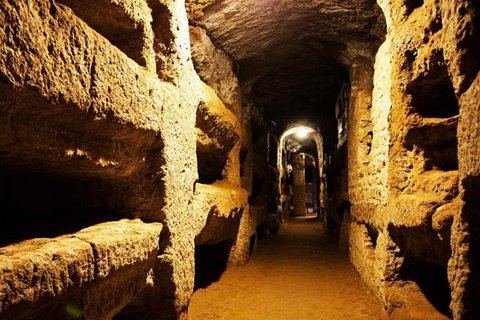 Underground Rome San Callisto Catacombs Guided Tour Experience
(opens in a new tab)
-
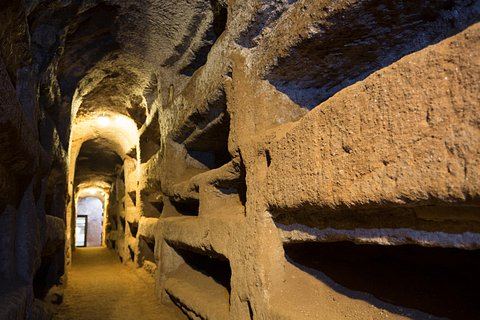 Private Tour to St. Callixtus Catacombs and Ancient Appian Way
Private
(opens in a new tab)
-
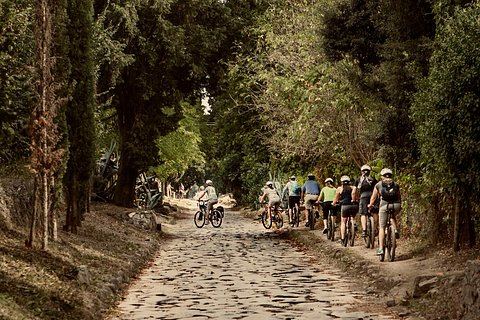 Rome Bike / EBike Tour: Appian Way, Catacombs & Roman Aqueducts
Free cancellation
(opens in a new tab)
Affiliate link Viator · If you book through this link, we may earn a commission at no extra cost to you.