
Written by  Maria Torres · Updated 2026-11-20
- Category
- Neighborhoods
Trastevere, Rome's 13th rione, takes its name from the Latin trans Tiberim, "beyond the Tiber," and its residents, the Trasteverini, have long thought of themselves as a people apart. Its heart is Piazza di Santa Maria in Trastevere, where the octagonal fountain already appears on a map of 1472 and the basilica, rebuilt in 1140–43 under Pope Innocent II, holds Pietro Cavallini's mosaics of the Life of the Virgin from 1291. From there cobbled lanes lead to Piazza Trilussa and its fountain by Ponte Sisto, the basilica of Santa Cecilia and Villa Farnesina on Via della Lungara. Come by day for the churches and in the evening for the trattorias and bars, and on Sunday morning add the flea market around Porta Portese.
Quick facts
- District
- Trastevere (Rione XIII), Municipio I
- Metro / train
- FL regional rail FL1 · Roma Trastevere
Sources · facts checked on 2026-11-16
- Trastevere – Wikipedia (en)
- Trastevere – Wikipedia (it)
- Festa de' Noantri – Wikipedia (it)
- Ponte Sisto – Wikipedia (en)
- Santa Cecilia in Trastevere – Wikipedia (en)
- San Francesco a Ripa – Wikipedia (en)
- Monumento a Giuseppe Gioachino Belli – Wikipedia (it)
- ATAC – Modernisation of the tramway network (Feb 2026)
Rome's district beyond the river
Trastevere is the 13th of Rome's historic rioni, part of Municipio I, and its name comes from the Latin trans Tiberim, "beyond the Tiber." It fills the land on the west bank between the river's bend and the slope of the Janiculum, south of the Vatican. The rione covers about 1.8 square kilometers and has roughly 13,400 residents. To the east the Tiber separates it from Regola, Ponte and Ripa; to the west it ends at the Aurelian Walls, beyond which the Gianicolense district begins.
Residents call themselves Trasteverini, and for centuries the rivalry with the Monticiani of Monti, on the other side of the city, ended in street fights.
From Etruscan bank to papal rione
In Rome's earliest centuries this bank was Etruscan territory, the Ripa Etrusca, linked to the city only by the wooden Pons Sublicius. Sailors and fishermen settled here, along with immigrants from Syria and Judea, and under Augustus the area became the 14th of the city's regions, Transtiberim. Aurelian's walls of the 270s enclosed part of the district, with gates at Porta Settimiana, Porta San Pancrazio and Porta Portuense.
From the late Republic to the 16th century Trastevere was home to an important Jewish community. A medieval building at Vicolo dell'Atleta 14, now used commercially, is identified as Rome's oldest surviving synagogue, linked to the scholar Nathan ben Yechiel; it lost that role when the Jews were moved into the Jewish Ghetto across the river in the mid-16th century.
Pope Sixtus IV reshaped the district at the end of the 15th century: he had the streets paved, first with brick and then with sampietrini cobbles, and built Ponte Sisto between 1473 and 1479. Sixtus V fixed the 14 historic rioni in 1586, with Trastevere as number XIII. Water arrived in 1612 through Paul V's Acqua Paola aqueduct, Urban VIII added the Janiculum walls in 1643 (rebuilding Porta Portese in its present position), and in 1744 Benedict XIV drew the boundaries the rione still has. The wide Viale di Trastevere was cut through in the 19th century.
Churches and what to see inside
Two of Rome's oldest churches stand here. Santa Maria in Trastevere, on the square of the same name, was rebuilt in 1140–43 under Pope Innocent II and holds Pietro Cavallini's mosaics of the Life of the Virgin from 1291. Santa Cecilia in Trastevere, rebuilt by Pope Paschal I in 822, keeps its 9th-century apse mosaic of Christ with saints, including Cecilia and Paschal himself. Under Arnolfo di Cambio's ciborium of 1293 lies Stefano Maderno's marble statue of the martyr, carved in 1600 after her tomb was opened in 1599. In the nuns' choir is Cavallini's fresco of the Last Judgment, plastered over in 1724 and rediscovered in 1900; it can be seen only at limited times through the Benedictine nuns. Excavations under the church have uncovered a Roman house of the early Empire.
San Francesco a Ripa, near the river at the southern end of the rione, stands next to the convent where Francis of Assisi stayed. The present church was begun in 1603. In the Paluzzi-Albertoni chapel in the left transept is Gian Lorenzo Bernini's Blessed Ludovica Albertoni (1671–75), a reclining figure that recalls his Ecstasy of Saint Teresa. San Crisogono on Viale di Trastevere is the church of the Carmelites, linked to the Madonna del Carmine venerated in the district.
Squares, streets and the riverfront
Piazza di Santa Maria in Trastevere, with its octagonal fountain, is the center of the rione. Piazza Trilussa, by the river, has the Fontana di Ponte Sisto and a monument to the dialect poet Trilussa. From there Ponte Sisto, pedestrian-only since 2000, crosses to Via dei Pettinari, a short walk from Campo de' Fiori. At the other end of the district, near Ponte Garibaldi, Piazza Belli has Michele Tripisciano's monument to Giuseppe Gioachino Belli, the poet of the Roman-dialect sonnets, unveiled on May 4, 1913, in the presence of Mayor Ernesto Nathan.
Piazza San Cosimato hosts the neighborhood's food market, the San Cosimato Market (Mercato di Piazza San Cosimato). North of Porta Settimiana, Via della Lungara runs straight toward the Vatican past Villa Farnesina, Palazzo Corsini, whose grounds hold the Rome Botanical Garden (Orto Botanico), and the Regina Coeli prison. Uphill from the lanes, the Acqua Paola Fountain (Fontana dell'Acqua Paola) and the terraces of the Janiculum Hill (Gianicolo) give the widest views over the center. On Sunday mornings the Porta Portese Flea Market (Mercato di Porta Portese) fills the streets at the southern edge.
The Festa de' Noantri in July
Trastevere's own festival runs in the second half of July, around July 16, the feast of Our Lady of Mount Carmel. Local tradition holds that in 1535 fishermen found a cedar-wood statue of the Virgin at the mouth of the Tiber after a storm; it was entrusted to the Carmelites of San Crisogono and became the protector of the rione. The popular festival in its present form dates from the 1920s.
On the Saturday after July 16 a 19th-century polychrome statue of the Madonna del Carmine is carried from the church of Sant'Agata to San Crisogono and back, and it stays on display at Sant'Agata for a week. On the following Sunday it is taken by boat along the Tiber to Ponte Garibaldi, recalling where the original was found, and then carried to Santa Maria in Trastevere, where the festival closes.
Evenings, students and daily life
The narrow cobbled lanes around Santa Maria and Piazza Trilussa fill with trattorias, wine bars and pubs. The rione is also a university district: John Cabot University and The American University of Rome are here, and the American Academy in Rome sits on the Janiculum above.
How to get there
Trastevere has no metro station. Tram 8 runs between Piazza Venezia and Casaletto along Viale di Trastevere and continues south to Roma Trastevere railway station. During 2026 the line was replaced by buses on several occasions because of track works, so check ATAC notices before you rely on it.
Roma Trastevere station, south of the historic rione, is served by FL1 regional trains, which run to and from Fiumicino Airport (FCO) without passing through Roma Termini. On foot, Ponte Sisto links the district with Campo de' Fiori, and Ponte Garibaldi with Largo Arenula and the Jewish Ghetto.
Tips for your visit
Visit the churches in the morning or early afternoon, when they are quieter, and keep the evening for a meal; Santa Cecilia's Cavallini fresco has its own short visiting times, so check them in advance. A good loop runs from Ponte Sisto to Santa Maria in Trastevere, up to the Acqua Paola Fountain and the Janiculum, and back by Via della Lungara. If you come in late July, the Saturday and Sunday processions of the Festa de' Noantri are the moments to plan around.
Key places in Trastevere
The spots that define the district, from north to south.
Villa Farnesina
Where Via della Lungara
Renaissance villa with frescoes by Raphael's circle
Piazza Trilussa and Ponte Sisto
Where Riverfront, north end
Fountain, poet's monument and the 1470s pedestrian bridge to Campo de' Fiori
Santa Maria in Trastevere
Where Piazza di Santa Maria in Trastevere
12th-century basilica with Cavallini's 1291 mosaics
Piazza San Cosimato
Where South of Santa Maria
Neighborhood food market
San Crisogono
Where Viale di Trastevere
Carmelite church at the heart of the July Festa de' Noantri
Monument to G.G. Belli
Where Piazza Belli, by Ponte Garibaldi
Tripisciano's 1913 statue of the dialect poet
Santa Cecilia in Trastevere
Where Piazza di Santa Cecilia
Maderno's 1600 statue, Arnolfo's ciborium, Cavallini's Last Judgment
San Francesco a Ripa
Where Piazza di San Francesco d'Assisi
Bernini's Blessed Ludovica Albertoni (1671–75)
Church opening times change often; check with each church before you go.
Frequently asked questions
How do you get to Trastevere from the center of Rome?
Take tram 8 from Piazza Venezia along Viale di Trastevere, or walk across Ponte Sisto from Campo de' Fiori or across Ponte Garibaldi from the Jewish Ghetto. There is no metro station in Trastevere.
Can you get to Trastevere directly from Fiumicino Airport?
Yes. FL1 regional trains from Fiumicino Airport stop at Roma Trastevere station, south of the historic district, from where tram 8 runs into the center of the rione.
What is there to see in Trastevere?
The basilicas of Santa Maria in Trastevere and Santa Cecilia, Bernini's Blessed Ludovica Albertoni in San Francesco a Ripa, Piazza Trilussa and Ponte Sisto, Villa Farnesina on Via della Lungara and the views from the Janiculum.
What does Trastevere mean?
It comes from the Latin trans Tiberim, "beyond the Tiber," because the district lies on the west bank, opposite the ancient city.
When is the Festa de' Noantri?
In the second half of July, around the feast of Our Lady of Mount Carmel on July 16. The main procession is on the Saturday after July 16, and the river procession on the following Sunday.
Is Trastevere worth visiting at night?
Yes, the evening is when its trattorias, wine bars and squares are busiest; come earlier in the day if you want to see the church interiors.
Popular tours that include Trastevere
-
 Winner 2026: Rome Trastevere Luxury Food Tour with Fine Wine
Free cancellation
(opens in a new tab)
-
 Rome: Award Winning Trastevere Group Food Tour with Wine
Free cancellation
(opens in a new tab)
-
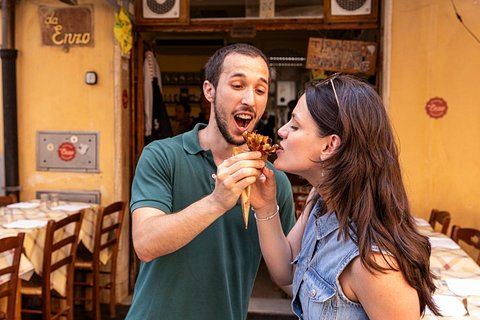 Winner 2026 Rome Twilight Trastevere Food Tour by Eating Europe
Free cancellation
(opens in a new tab)
Affiliate link Viator · If you book through this link, we may earn a commission at no extra cost to you.