
Written by  Maria Torres · Updated 2026-11-20
- Category
- Catacombs & Underground Rome
These catacombs gave the word catacomb its origin: the site was known in antiquity as ad catacumbas, after a hollow in the ground beside the Appian Way, and it is one of the few Christian burial places that has always remained accessible. Before the Christian galleries, the area held pozzolana quarries and then pagan tombs, including three mausoleums that survive in a small sunken square. Above them, a 3rd-century hall for funeral banquets bears more than 600 graffiti invoking the apostles Peter and Paul, whose relics tradition places here for a time. The 4th-century basilica above, San Sebastiano fuori le Mura, keeps Saint Sebastian's relics. San Callisto lies on the same stretch of the Appian Way.
Quick facts
- Address
- Via Appia Antica 136, Appia Antica & South Rome, 00179
- Opening hours
- Tue–Sun: 09:15–17:15
- Admission
- Paid (ticketed)
Why these catacombs gave the word its meaning
The Catacombs of San Sebastiano lie beneath the Basilica of San Sebastiano fuori le Mura at Via Appia Antica 136. In antiquity the spot was called ad catacumbas, usually explained as near the hollows, after the pozzolana quarries dug here before the cemetery. The name later spread to every underground Christian cemetery. This is also one of the few Christian catacombs that has remained continuously accessible since antiquity.
The quarry was turned into about 12 kilometers of galleries on three levels, reaching as deep as 18 meters. Tombs range from simple loculi (wall niches) to arcosolia (arched tombs); many were marked with a lamp fragment, a coin, a piece of jewelry or a child's toy pressed into the mortar, and some still show a name scratched into it.
History: quarry, pagan tombs and the apostles
The quarry was abandoned at the end of the 2nd century, and in the second half of that century three pagan mausoleums were built in a small sunken square, the piazzola: the tomb of Marcus Clodius Hermes on the right, the tomb of the Innocentiores, named after the funeral association that owned it, and the Tomb of the Axe (Ascia) on the left. They keep their original frescoes and stucco.
Around the middle of the 3rd century the piazzola was filled in and a courtyard was laid out above the mausoleums. Here the triclia was built, a covered hall reached by a short staircase, with a portico and a bench along three walls, used for funeral banquets. Its walls carry more than 600 graffiti invoking the apostles Peter and Paul, such as Paule et Petre petite pro Victore (Paul and Peter, pray for Victor). Tradition holds that the apostles' remains were brought here for a time during Valerian's persecution, and the Roman martyrology links a commemoration of Peter in catacumbas to the year 258. The complex became known as the Memoria Apostolorum.
Sebastian, a martyr buried on January 20, made the site a pilgrimage goal until the 6th century; tradition says his relics were carried in procession in 680 to ask for protection from plague. Excavations in 1892 showed that the structure known as the Platonia, once thought to be the apostles' temporary grave, was the mausoleum of the martyr Quirinus, a bishop from Pannonia.
The Basilica of San Sebastiano above
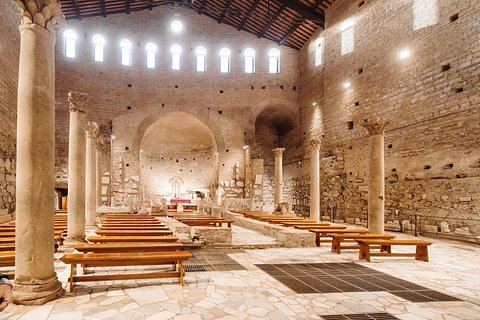
The church above the catacombs was built under Constantine in the 4th century as the Basilica Apostolorum, a circus-shaped hall in honor of Peter and Paul. Devotion to Sebastian later gave both church and catacomb their present name. In 1608 Cardinal Scipione Borghese began a complete remodeling to a design by Flaminio Ponzio, finished by Giovanni Vasanzio; only the nave of the ruined circus-shaped building was rebuilt, and the facade is dated 1612.
Inside, the altar of Saint Sebastian holds an urn with his remains under a reclining statue of the saint pierced by arrows, by Giuseppe Giorgetti. The Relics Chapel, commissioned in 1625 by Duke Maximilian of Bavaria, keeps an arrow said to be from his martyrdom, the column he was tied to and the Quo Vadis stone with the imprint of two feet venerated as Christ's footprints. Near the entrance is a verse inscription by Pope Damasus in honor of the martyr Eutychius, carved in Filocalian lettering. The basilica also holds Bernini's Salvator Mundi, his last work.
Tours, hours and tickets
A guide is compulsory and tours run in Italian, English, French, Spanish and German, lasting about 40 to 45 minutes. When checked in November 2026, the official site listed opening times of Tuesday to Sunday 9:15–17:15, with last entry at 16:45, closed on Mondays, December 25, January 1 and Easter Sunday, and for annual closure from December 7 to 27, 2026. The official adult ticket was €10 and the ticket for ages 7–16 €7; a guided tour booked online through the official reseller ORP was €12, and a free reservation paid on site was also possible. Check catacombe.org before you go.
The galleries stay at 17–18°C all year, so a light jacket is useful in summer.
How to get there and what to combine
ATAC bus 118 from Metro B Colosseo and bus 660 from Metro A Arco di Travertino both stop at Basilica e Catacombe di San Sebastiano, in front of the entrance. The Catacombs of San Callisto are on the same buses, a short way back toward the city on Via Appia Antica, so the two make an easy morning; note that San Sebastiano is closed on Mondays and San Callisto on Wednesdays. Private cars are banned from Via Appia Antica on public holidays. South of the basilica the road continues through the Appian Way Regional Park (Parco dell'Appia Antica).
Key sights at San Sebastiano
What the tour and the basilica above contain.
Piazzola mausoleums
Where Deepest part of the tour
Three 2nd-century pagan tombs, of Clodius Hermes, the Innocentiores and the Axe, with frescoes and stucco
Triclia
Where Above the mausoleums
3rd-century banquet hall with more than 600 graffiti invoking Peter and Paul
Christian galleries
Where Three levels, about 12 km
Loculi and arcosolia, many with small objects pressed into the mortar
Altar of Saint Sebastian
Where Basilica
Urn with his remains and Giorgetti's reclining statue
Relics Chapel
Where Basilica, 1625
Arrow, column and the Quo Vadis footprint stone
Salvator Mundi
Where Basilica
Bust by Gian Lorenzo Bernini, his last work
The basilica can be visited separately from the catacomb tour.
Frequently asked questions
Why are they called catacombs?
This site was known in antiquity as ad catacumbas, near the hollows, after the quarries beside the Appian Way. The name later passed to all Christian underground cemeteries.
What are the opening hours of the Catacombs of San Sebastiano?
When checked in November 2026: Tuesday to Sunday 9:15–17:15, last entry 16:45, closed Mondays and from December 7 to 27, 2026. Check catacombe.org before you go.
How long does the San Sebastiano catacombs tour take?
About 40 to 45 minutes, always with a guide.
How do I get to the Catacombs of San Sebastiano?
Take bus 118 from Metro B Colosseo or bus 660 from Metro A Arco di Travertino to the Basilica e Catacombe di San Sebastiano stop.
Can I visit San Sebastiano and San Callisto on the same day?
Yes. They are on the same stretch of Via Appia Antica and the same bus routes; avoid Mondays (San Sebastiano closed) and Wednesdays (San Callisto closed).
Popular tours that include Catacombs of San Sebastiano (Catacombe di San Sebastiano)
-
 Rome Underground: Catacombs Tour, Aqueducts and Appian Way
Free cancellation
(opens in a new tab)
-
 Appia Antica: History and Gluten-Free Flavors
Free cancellation
(opens in a new tab)
Affiliate link Viator · If you book through this link, we may earn a commission at no extra cost to you.