
Written by  Maria Torres · Updated 2026-11-20
- Category
- Churches & Basilicas
- Area
- Centro Storico
The Gesù is the mother church of the Jesuits, first conceived by St. Ignatius of Loyola in 1551. Construction began on June 26, 1568 to Giacomo Barozzi da Vignola's design, Giacomo della Porta reworked the façade, and the church was consecrated in 1584; its design became the model for Jesuit churches around the world. Look up at Giovanni Battista Gaulli's ceiling fresco, the Triumph of the Name of Jesus (1678–1679); Gaulli also painted the dome and the transept ceilings. In the left transept, Andrea Pozzo's chapel of St. Ignatius (1696–1700) holds the saint's tomb, lapis lazuli-veneered columns and a counterweight mechanism that lowers the altarpiece canvas to reveal a statue of Ignatius on solemn feasts.
Quick facts
- Address
- Piazza del Gesù, Pigna, 00186
- Metro / train
- ATAC tram 8 · Piazza Venezia
- Completed
- 1584
- Architect
- Jacopo Barozzi da Vignola; Giacomo della Porta
Sources · facts checked on 2026-11-16
What the Gesù is
The Church of the Most Holy Name of Jesus, the Gesù, is the mother church of the Society of Jesus, the order founded by St. Ignatius of Loyola. It stands on Piazza del Gesù, a few steps off Via del Plebiscito between Piazza Venezia and Largo di Torre Argentina. It was the largest church built in Rome after the Sack of 1527 and the first entirely new one, and its plan, a single wide nave with interconnecting side chapels instead of aisles, was copied by Jesuit churches across Europe and the Americas.
The nave is about 75 m long and 35 m wide, and the whole space is built to direct the eye to the altar and up to the vault, where most visitors end up looking.
Baciccio's ceiling: the Triumph of the Name of Jesus
Giovanni Battista Gaulli, known as Baciccio, painted the nave vault with the Triumph of the Name of Jesus in 1678–1679. The IHS monogram glows at the center, and painted figures of the damned tumble out of the frame over the gilded coffering, so that it is hard to tell where the painting stops and the architecture starts. The stucco angels on the gilded frame are by Antonio Raggi, to Gaulli's design. Gaulli also frescoed the dome, its pendentives, the transept ceilings and the apse.
The colored marble cladding of the nave walls came much later, paid for by Prince Alessandro Torlonia in 1858–1861.
The chapel of St. Ignatius and its Baroque machine
The left transept holds the tomb of St. Ignatius in a chapel designed by the Jesuit painter and architect Andrea Pozzo in 1696–1700. Its columns are faced with lapis lazuli, and the altar mixes alabaster, onyx, verde antico, amethyst and rock crystal. Above, the Trinity sits over a globe decorated with lapis lazuli. The saint's remains lie in a gilded bronze urn by Alessandro Algardi, flanked by two marble groups: Pierre Legros's Religion Overthrowing Heresy and Jean-Baptiste Théodon's Faith Triumphing over Idolatry.
Pozzo's large altar canvas, showing Ignatius receiving the IHS standard from the risen Christ, works like a stage curtain: a counterweight mechanism, restored in 2007, lowers it to reveal the statue of the saint in a niche behind. The original silver statue by Pierre Legros was melted down during the French occupation of 1798; only the chasuble survived, and the missing parts were remade in silver-plated stucco in Antonio Canova's studio, probably by Adamo Tadolini. The canvas is lowered on solemn feasts and in a daily late-afternoon presentation with music; ask at the sacristy for the current time.
Other chapels and relics
The right transept is the chapel of St. Francis Xavier, designed by Pietro da Cortona, with Carlo Maratta's Death of St. Francis Xavier (1679) on the altar; the church also keeps a relic of Xavier's right arm. The Madonna della Strada chapel, left of the high altar, is named after the medieval image Ignatius prayed before in the small church that stood on this site. In the presbytery is a bust of Cardinal Robert Bellarmine by Gian Lorenzo Bernini, and the third chapel on the right has paintings by Federico Zuccari.
The high altar was rebuilt in the mid-19th century to a design by Antonio Sarti, with Alessandro Capalti's Circumcision as its altarpiece. Della Porta's original tabernacle went to Thurles Cathedral in Ireland.
History: Ignatius, Farnese, Vignola and della Porta
Ignatius wanted a new church from 1551 and asked the Florentine architect Nanni di Baccio Bigio for a design; Michelangelo redrew the plan in 1554, but neither was built. Cardinal Alessandro Farnese, grandson of Pope Paul III, financed the project, and building began on June 26, 1568 to the design of Jacopo Barozzi da Vignola, with the Jesuit architects Giovanni Tristano and Giovanni de Rosis. After Vignola's death in 1573, Giacomo della Porta completed the dome and apse and replaced Vignola's façade with his own design, which carries the IHS emblem. The church was consecrated on November 25, 1584.
The Jesuits lost much of the church's treasure after the suppression of the order in 1773 and recovered the building in 1814. The rooms where Ignatius lived and died are in the adjoining Jesuit residence and can be visited by arrangement; write to [email protected].
Getting there and visiting tips
No metro station is close. Many ATAC buses stop at Largo di Torre Argentina and Piazza Venezia, both a few minutes' walk away, and the terminus of tram 8 is next to Piazza Venezia; during 2026 network works tram 8 was at times replaced by buses, so check atac.roma.it.
In November 2026 the church listed winter hours (late September to June 29) of Monday to Friday 7:30–12:30 and 16:30–19:30, Saturday 7:30–12:30 and 16:30–20:00, and Sundays and holidays 8:30–13:30 and 16:30–20:00, with shorter summer hours; tourist visits stop during services and 30 minutes before each Mass. Check before you go. Allow 30 to 45 minutes, and combine the Gesù with Sant'Ignazio di Loyola, where Pozzo painted another illusionistic ceiling, Santa Maria sopra Minerva and the Pantheon, all within a short walk.
Key works in the Gesù
Where to find the main works, from the entrance toward the altar.
Triumph of the Name of Jesus
Where Nave vault
Baciccio's illusionistic ceiling fresco, 1678–1679, with stucco figures by Antonio Raggi
Chapel of St. Ignatius
Where Left transept
Andrea Pozzo's altar (1696–1700) over the saint's tomb, with the lowering canvas and silvered statue
Chapel of St. Francis Xavier
Where Right transept
Designed by Pietro da Cortona, altarpiece by Carlo Maratta (1679)
Madonna della Strada chapel
Where Left of the high altar
Chapel of the medieval Marian image venerated by St. Ignatius
Bust of Robert Bellarmine
Where Presbytery
Portrait of the Jesuit cardinal by Gian Lorenzo Bernini
Chapels may be roped off during Mass.
Frequently asked questions
What time does the St. Ignatius statue appear at the Gesù?
The altar canvas is lowered in a daily late-afternoon presentation and on solemn feasts. The time can change, so ask at the church or check its website.
What are the opening hours of the Church of the Gesù?
In November 2026 the church opened Monday to Friday 7:30–12:30 and 16:30–19:30, with slightly longer Saturday and Sunday evenings and shorter summer hours. Visits stop during Mass, so check before you go.
Who painted the ceiling of the Gesù?
Giovanni Battista Gaulli, known as Baciccio, painted the Triumph of the Name of Jesus in 1678–1679, with stucco figures by Antonio Raggi.
Is St. Ignatius of Loyola buried in the Gesù?
Yes. His remains lie in a gilded bronze urn by Alessandro Algardi under Andrea Pozzo's altar in the left transept.
How do I get to the Church of the Gesù?
Walk from Largo di Torre Argentina or Piazza Venezia, both served by many ATAC buses; there is no metro station nearby.
Can you visit the rooms of St. Ignatius?
Yes, by arrangement: the church asks visitors to write to [email protected].
Popular tours that include Church of the Gesù (Chiesa del Gesù)
-
 Rome: Golf Cart Panoramic City Tour
Free cancellation
(opens in a new tab)
-
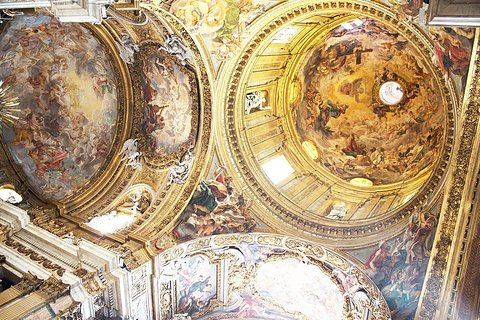 Jesuit Art Treasures in Rome Guided Tour including Church of Gesù & St Ignatius
Free cancellationPrivate
(opens in a new tab)
Affiliate link Viator · If you book through this link, we may earn a commission at no extra cost to you.