
Written by  Maria Torres · Updated 2026-11-20
- Category
- Churches & Basilicas
San Clemente lets you walk down through three layers of Roman history. The upper church was rebuilt around 1099–1120 and keeps its medieval layout; beneath it is a 4th-century basilica with 11th-century frescoes of the life of St. Clement; and at the lowest level lie a Roman house and a 2nd-century mithraeum, with an altar showing Mithras slaying a bull. The excavations began in the 1860s under Joseph Mullooly, prior of the Irish Dominicans, who have run the church since 1667. A side chapel holds the tomb of St. Cyril, who with Methodius brought Christianity and an alphabet to the Slavs. Allow about an hour to see all three levels.
Quick facts
- Address
- Via Labicana 95 (entrance on Piazza di San Clemente), Celio, 00184
- Metro / train
- Metro B B · Colosseo (~7 min walk)
- Metro / train
- Metro C C · Colosseo (~7 min walk)
Three churches stacked on top of each other
The Basilica of San Clemente, officially San Clemente al Laterano, is dedicated to Pope Clement I, one of the first bishops of Rome. Its appeal lies in its layers. At street level is a 12th-century basilica; under it is a church that already existed by 392, when St. Jerome mentioned it; and below that are 1st-century Roman buildings and a sanctuary of the god Mithras. Stairs take you down from one level to the next, so in a single visit you go from medieval Rome to the city of the emperors.
Since 1667 the complex has belonged to the Irish Dominicans, who were given refuge here by Pope Urban VIII. Their prior Joseph Mullooly began digging out the lower church in the 1860s, and the excavations have continued in stages ever since.
The upper basilica: mosaic, choir enclosure and Masolino
The present church was rebuilt by Cardinal Anastasius around 1099–1120, after the old basilica had fallen into poor condition; the fire set by Robert Guiscard's Norman troops when they sacked this part of Rome in 1084 is often given as one reason. It has three naves, a Cosmatesque floor of inlaid colored marble and, in the middle of the nave, a 12th-century schola cantorum, the walled enclosure for the choir. Its marble panels were reused from the lower church and carry the monogram of Pope John II, who donated them in the 6th century.
The apse mosaic, the Triumph of the Cross, is one of the high points of 12th-century Roman mosaic. Christ hangs on a cross between the Virgin and St. John; twelve white doves on the cross stand for the apostles, and the cross grows out of an acanthus plant whose scrolls spread across the whole apse, filled with birds, cupids riding dolphins, shepherds and fountains. A Latin inscription compares the Church to a vine that the Law withers and the Cross makes green again.
Near the entrance, the Chapel of St. Catherine holds frescoes by Masolino da Panicale, painted between 1428 and 1431 for Cardinal Branda Castiglioni, the church's titular cardinal. They include an Annunciation; Masaccio, who died in Rome in 1428, may have started the work. The Baroque façade facing the atrium was designed by Carlo Stefano Fontana and completed in 1719 under Pope Clement XI.
The lower basilica and its medieval frescoes
The lower church was the scene of church councils under Popes Zosimus in 417 and Symmachus in 499, and Cardinal Rainerius was elected Pope Paschal II here in 1099. It holds one of the largest collections of early medieval wall paintings in Rome. The best known were paid for in the late 11th century by Beno de Rapiza and his wife Maria Macellaria and show the life and miracles of St. Clement and the legend of St. Alexius.
Look for the fresco of the pagan Sisinnius shouting at his servants as they drag a heavy load. His words are painted beside him in early Italian rather than Latin, including the line "Fili de le pute, traite" ("Pull, you sons of whores"), one of the earliest known examples of written Italian vernacular. The saint answers in Latin that the pagans deserve to drag stones because of their hard hearts.
St. Cyril, the missionary who with his brother Methodius brought Christianity to the Slavs and created the Glagolitic alphabet, was buried in the lower church in 869. His remains were later moved to the upper church, and a side chapel there is dedicated to him. Pope John Paul II prayed here for Poland and the Slavic countries.
The Roman level and the mithraeum
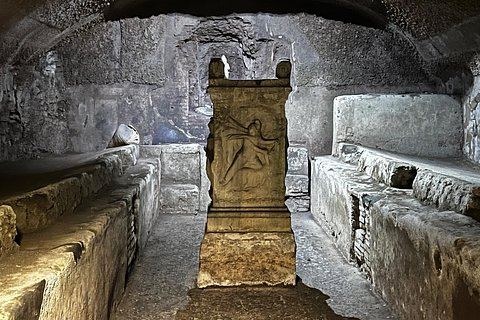
The bottom level takes you about two thousand years back. Here are the walls of a 1st-century AD Roman building, probably a warehouse, and of a house whose courtyard held a mithraeum, a temple of the cult of Mithras popular with Roman soldiers and merchants, set up around AD 200. The main cult room, about 9.6 by 6 meters, was found in 1867. Its altar is carved with the tauroctony, Mithras slaying a bull.
How to get there
San Clemente is about a five-minute walk east of the Colosseum (Colosseo). Take Metro B or Metro C to Colosseo, then walk along Via Labicana or Via di San Giovanni in Laterano. The official address is Via Labicana 95, but the entrance for both the basilica and the excavations is on Piazza di San Clemente, on the Via di San Giovanni in Laterano side. Continuing along that street you reach St. John Lateran (San Giovanni in Laterano), and the Case Romane del Celio, another set of Roman houses under a church, are a short walk south on the Celio.
Tickets, hours and rules
Entry to the excavations, which include the lower basilica and the Roman level, requires a ticket and an online booking made in advance, and you should be at the entrance 10 minutes before your time slot. In November 2026 the official site listed €10 for a full ticket and €7 for students under 21 with a student card, with free entry for children under 16 with a paying adult and for disabled visitors and a carer. Hours listed then were Monday to Saturday 9:00–12:30 and 14:00–18:00, and Sundays and holidays 12:00–18:00, with last entry 30 minutes before closing. Check the official site before you go.
Photography and filming are not allowed in the basilica or the excavations, and staff may ask offenders to leave. Large bags and luggage, food and drinks are not permitted, and the excavations are not accessible by wheelchair, since they are reached by stairs. Allow about an hour to see all three levels at an unhurried pace.
What to see on each level
San Clemente is visited from the top down. These are the key sights at each level.
Apse mosaic (Triumph of the Cross)
Level Upper basilica
12th-century mosaic of the cross as a tree of life, with twelve doves and vine scrolls
Schola cantorum
Level Upper basilica, center of the nave
Marble choir enclosure reusing 6th-century panels with Pope John II's monogram
Chapel of St. Catherine
Level Upper basilica, near the entrance
Frescoes by Masolino, 1428–1431, including an Annunciation
Sisinnius fresco
Level Lower basilica
11th-century scene with one of the earliest written examples of Italian vernacular
Mithraeum
Level Roman level
Cult room of Mithras from around AD 200 with a bull-slaying altar
The lower basilica and Roman level are reached with the excavations ticket; booking is required.
Frequently asked questions
Is the Basilica of San Clemente worth visiting?
Yes, if you want to see Rome's layers in one place: a 12th-century church with a celebrated apse mosaic, a 4th-century church with 11th-century frescoes, and a Roman mithraeum from around AD 200 at the bottom.
Do you need to book San Clemente in advance?
Online booking is required for the excavations, which cover the lower basilica and the Roman level. Arrive 10 minutes before your time slot.
How much does it cost to visit the San Clemente excavations?
In November 2026 the official site listed €10 for a full ticket and €7 for students under 21 with a student card. Check the official site before you go.
How long does a visit to San Clemente take?
About an hour for all three levels.
How do I get to San Clemente from the Colosseum?
It is about a five-minute walk east of the Colosseum; the nearest station is Colosseo on Metro B and Metro C. The entrance is on Piazza di San Clemente.
Can you take photos in San Clemente?
No. Photography and filming are not allowed in the basilica or in the excavations.
Popular tours that include Basilica of San Clemente
-
 Basilica of San Clemente Underground and Colosseum Experience
(opens in a new tab)
-
 Rome: San Clemente Underground and Basilica Small Group Tour
Free cancellation
(opens in a new tab)
-
 Rome: Underground Secrets and Mysteries Private Tour
Free cancellationPrivate
(opens in a new tab)
Affiliate link Viator · If you book through this link, we may earn a commission at no extra cost to you.