
Written by  Maria Torres · Updated 2026-11-20
- Category
- Churches & Basilicas
- Area
- Ostiense & EUR
Built outside the Aurelian Walls over the traditional burial place of St. Paul, this is one of Rome's four papal basilicas. Constantine founded the first church, consecrated in 324; a larger basilica followed from 386, but a fire on July 15, 1823 destroyed most of it. The transept and high altar were consecrated in 1840; Pius IX consecrated the rebuilt basilica in 1854, and façade and quadriporticus work continued to 1928. 80 columns line the nave; the apostle's tomb is marked by a marble slab inscribed PAULO APOSTOLO MART beneath the high altar and Arnolfo di Cambio's 1285 ciborium. Save time for the cloister by the Vassalletto workshop between 1205 and 1241, with paired columns inlaid with gold and glass.
Quick facts
- Address
- Piazzale San Paolo, 1, Ostiense — San Paolo, 00146
- Metro / train
- Metro B · Basilica San Paolo
- Metro / train
- Roma–Lido · Basilica San Paolo
- Opening hours
- Daily: 07:00–18:30
- Admission
- Free
- Architect
- Pasquale Belli; Luigi Poletti
What St. Paul Outside the Walls is
St. Paul Outside the Walls is one of Rome's four papal basilicas and, after St. Peter's, the largest church in the city. It stands on Via Ostiense south of the Aurelian Walls, over the place where tradition says the apostle Paul was buried after his execution. The church is served by a community of Benedictine monks, whose abbey adjoins it, and it is property of the Holy See with extraterritorial status in Italian territory.
What you see today is largely a 19th-century reconstruction of the late-4th-century basilica, built to the same plan and size: about 131 m long, 65 m wide and nearly 30 m high, with five aisles divided by 80 granite columns.
History: Constantine, Theodosius and the fire of 1823
Christians first marked the grave with a memorial chapel. Constantine replaced it with a small basilica, consecrated by Pope Sylvester I in 324. In 386 Emperor Theodosius I began a far larger church, with a nave, four aisles and a transept; it was probably consecrated around 402 under Pope Innocent I, and its mosaics were finished under Leo I (440–461).
On the night of July 15, 1823, a fire started by a workman repairing the copper roof gutters burned for about five hours and destroyed most of the basilica. The transept, some mosaics and Arnolfo di Cambio's ciborium survived. Leo XII launched the rebuilding in 1825; Pasquale Belli led the work until his death in 1833, and Luigi Poletti then directed it until 1869. Gregory XVI consecrated the transept and high altar in October 1840, and Pius IX consecrated the whole basilica in 1854. Work on the façade and forecourt continued long after.
The forecourt and the façade
You enter through the quadriporticus, a colonnaded courtyard 70 m on each side built between 1890 and 1928 by Giuseppe Sacconi and Guglielmo Calderini on an initial design by Poletti, with palms and a Carrara marble statue of St. Paul holding a sword by Giuseppe Obici in the center. The gold-ground mosaics on the upper façade were made between 1854 and 1874 to designs by Filippo Agricola and Nicola Consoni.
The bronze Byzantine door commissioned in 1070 by Pantaleone of Amalfi, with scenes from the lives of Christ and the apostles, served as the main entrance until 1967. The Holy Door, designed by Enrico Manfrini, is opened only in Jubilee years.
Inside: popes, mosaics and the tomb of St. Paul
Above the columns runs a frieze of mosaic medallions with portraits of every pope, 267 in all, with 25 empty frames left for future popes; a popular legend says the world will end when the spaces run out. The triumphal arch keeps its 5th-century mosaic, which its inscription credits to the empress Galla Placidia, and the apse mosaic of Christ enthroned was commissioned under Honorius III (1216–1227) with craftsmen who had worked on St. Mark's in Venice. The two altars at the ends of the transept are faced with malachite given by Tsar Nicholas I.
The high altar stands under the Gothic ciborium Arnolfo di Cambio made in 1285. Beneath it lies a marble slab inscribed PAULO APOSTOLO MART ("to Paul, apostle and martyr") and a sarcophagus traditionally believed to hold Paul's remains. Excavations from 2002 to 2006 exposed the sarcophagus, and in 2009 radiocarbon tests on bone fragments inside dated them to the 1st or 2nd century. Nearby stands the 12th-century Paschal candlestick, a carved marble column made in 1170 by Nicolò d'Angelo and Pietro Vassalletto.
The cloister
The cloister on the south side, built by the Vassalletto workshop between 1205 and 1241, has paired columns in a variety of twisted and straight forms inlaid with gold and colored glass mosaic, and a frieze with animal-head water spouts. The walks display inscriptions and sarcophagus fragments from the old basilica. Unlike the church, it has an admission charge.
How to get there
Take Metro B to Basilica San Paolo, a station at Viale Giustiniano Imperatore and Via Gaspare Gozzi, behind the basilica; walk around the side of the church to the entrance. The same station is on the Roma–Lido railway, so the basilica fits easily into a day trip to Ostia Antica. Metro B also links the basilica with Roma Termini and the Colosseum (Colosseo) without changes.
Tips for your visit
Allow about an hour, including the cloister. In November 2026 the official site gave the basilica as open daily from 07:00 to 18:30 with free entry and the cloister daily from 08:00 to 18:00 (last entry 17:30) for €4 (reduced €3); check before you go, as times can change. If you are coming from Testaccio or the Circus Maximus (Circo Massimo), Metro B from Piramide or Circo Massimo gets you here in a few stops.
Frequently asked questions
How do I get to St. Paul Outside the Walls?
Take Metro B to Basilica San Paolo, which is directly behind the basilica. The station is also on the Roma–Lido railway to Ostia.
Is St. Paul Outside the Walls free?
Yes, the basilica is free. The cloister cost €4 (reduced €3) when we checked the official site in November 2026.
What are the opening hours of St. Paul Outside the Walls?
In November 2026 the official site listed the basilica as open daily 07:00–18:30 and the cloister 08:00–18:00, last entry 17:30. Check before you go.
Is St. Paul really buried there?
A sarcophagus beneath the high altar is traditionally believed to hold his remains, under a slab inscribed PAULO APOSTOLO MART. Bone fragments tested in 2009 were dated to the 1st or 2nd century.
Is St. Paul Outside the Walls worth visiting?
It is the second-largest church in Rome, with 80 columns, a mosaic portrait of every pope, a 5th-century triumphal arch, Arnolfo di Cambio's 1285 ciborium and a 13th-century cloister, and it is easy to reach on Metro B.
Why is it called 'outside the walls'?
It was built over Paul's grave on Via Ostiense, beyond the Aurelian Walls, because Roman burials took place outside the city.
Popular tours that include St. Paul Outside the Walls (San Paolo fuori le Mura)
-
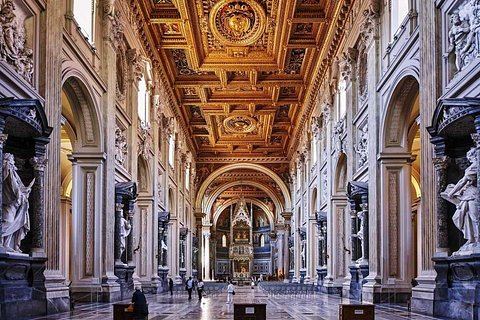 Papal Basilicas: St. John Lateran, Saint Mary Major, St. Paul outside the walls
Free cancellationPrivate
(opens in a new tab)
-
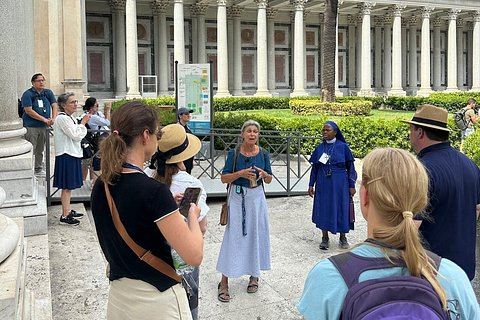 Rome Private Tour St. Paul Outside the Walls and Archaeo
Free cancellationPrivate
(opens in a new tab)
-
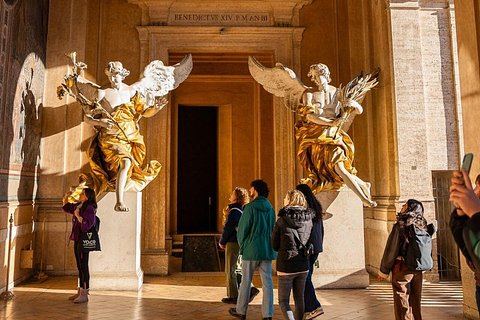 Private Jubilee Tour: 3 Papal Basilicas with Santa Maria Maggiore
Free cancellationPrivate
(opens in a new tab)
Affiliate link Viator · If you book through this link, we may earn a commission at no extra cost to you.