
Written by  Maria Torres · Updated 2026-11-20
- Category
- Museums & Galleries
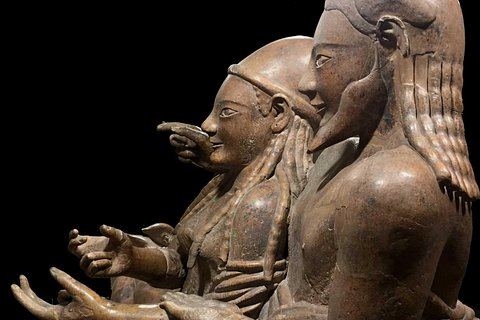
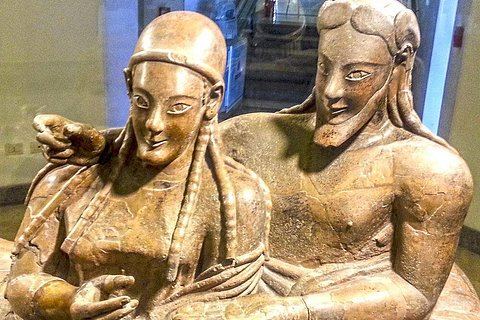
The National Etruscan Museum was founded in 1889 and occupies Villa Giulia, the suburban residence built in 1551–1553 for Pope Julius III to designs by Vignola, Vasari and Ammannati. It is devoted to the Etruscan and Faliscan peoples of pre-Roman central Italy. The best-known piece is the terracotta Sarcophagus of the Spouses, a couple reclining as if at a banquet; nearby are the Apollo of Veii and the Pyrgi Tablets, inscribed in Etruscan and Phoenician. The painted panels of the Tomba François from Vulci, made around 340–320 BC, have now entered the collection permanently. Since 2012 some rooms have also opened in the neighboring Villa Poniatowski, and the Galleria Nazionale is close by.
Quick facts
- Address
- Piazzale di Villa Giulia 9, Valle Giulia (Villa Borghese & Flaminio), 00196
- Metro / train
- Metro A A · Flaminio (~14 min walk)
- Metro / train
- ATAC tram 19 · Museo Etrusco Villa Giulia (~2 min walk)
- Opening hours
- Tue–Sun: 08:30–19:30
- Admission
- Paid (ticketed)
- Opened
- 1889
- Architect
- Jacopo Barozzi da Vignola, Bartolomeo Ammannati, Giorgio Vasari
Official website → Open in OpenStreetMap →
Sources · facts checked on 2026-11-16
- ETRU – Prepara la visita (official)
- ETRU – Museo Nazionale Etrusco di Villa Giulia (official)
- ETRU – La storia del museo (official)
- ETRU – Gli spazi (official)
- ETRU – Capolavori (official)
- ETRU – Sarcofago degli Sposi (official)
- ETRU – Apollo di Veio (official)
- ETRU – Lamine d'oro da Pyrgi (official)
What the museum is
The National Etruscan Museum, which brands itself ETRU, is Italy's main collection of art from the Etruscans and Faliscans, the peoples of central Italy before Roman rule. It gathers finds from the great Etruscan cities north of Rome, among them Veii, Cerveteri, Pyrgi, Vulci and Tarquinia, together with Faliscan material from Falerii. More than 6,000 objects are displayed in 50 rooms, over 3,000 square meters (about 32,000 square feet) of exhibition space.
The museum occupies Villa Giulia, the Renaissance villa of Pope Julius III on the Via Flaminia side of Valle Giulia. A second seat, Villa Poniatowski next door, opened in 2012 with finds from Latium Vetus and Umbria.
Masterpieces to see
The Sarcophagus of the Spouses (Sarcofago degli Sposi), made around 530–520 BC, was found in 1881 in about 400 fragments in the Banditaccia necropolis at Cerveteri. In painted terracotta, a couple reclines together as if at a banquet, about to share wine; the faces wear the archaic smile and the empty eyes were once painted black and white. The woman wears a pointed tutulus cap and upturned shoes. Only one other sarcophagus of this type is known, in the Louvre.
The Apollo of Veii (510–500 BC) is a painted terracotta statue that stood on the roof ridge of the Portonaccio temple at Veii, dedicated to the goddess Menerva. It was found in May 1916. Apollo strides toward Heracles, who has captured the golden-horned hind sacred to Artemis; the head of Mercury from the same group is shown in the same room. The statues are linked to the workshop of Vulca, the artist credited with the cult statue of Jupiter on the Capitoline.
From Pyrgi, the port of Cerveteri at modern Santa Severa, come the three gold Pyrgi Tablets of the late 6th century BC, found on July 8, 1964: two texts in Etruscan and one in Phoenician record a dedication by Thefarie Velianas, ruler of Caere, to the goddess Uni, called Astarte in Phoenician. Pyrgi also produced a terracotta high relief from Temple A (470–460 BC) showing the Seven against Thebes, with Tydeus gnawing the skull of Melanippus, and a head of Leucothea from 340–330 BC. Other well-known pieces are the bronze Cista Ficoroni, the Chigi olpe and the jewelry of the Castellani collection.
The Tomba François frescoes
The newest addition is the painted cycle of the Tomba François from Vulci, built around 340–320 BC for the Saties family. The Florentine archaeologist Alessandro François discovered the tomb in 1857 on land owned by Prince Alessandro Torlonia. The paintings, 37 panels detached from the walls, stayed in the Torlonia family's hands for more than 150 years until the Italian state bought them in May 2026.
The scenes mix Greek myth and Etruscan history: Achilles sacrificing 12 Trojan prisoners at the pyre of Patroclus, the freeing of the Etruscan noble Caelius Vibenna (Caile Vipinas) by his companions, and a frieze of griffins, lions, panthers, deer and boars. Since July 1, 2026 they have been displayed in galleries arranged to follow the plan of the tomb's main chamber, with the exhibition Il Ritorno degli Eroi running until December 31, 2026; after that they join the permanent collection. Entry is included in the museum ticket but timed and bookable, and the frescoes are not shown on free-admission days.
Villa Giulia: the pope's villa
Pope Julius III had the villa built in the early 1550s as a suburban retreat, then on the edge of the city; papal parties arrived by boat up the Tiber. Jacopo Barozzi da Vignola designed the casino with its curved loggia, Bartolomeo Ammannati the nymphaeum and garden structures, and Giorgio Vasari oversaw the works, with a contribution from Michelangelo. Prospero Fontana led the painted decoration with a team that included the young Taddeo Zuccari; the vault of the semicircular portico is painted with grotesques inspired by the Domus Aurea.
The nymphaeum, sunk below the courtyard on two levels, is fed by the ancient Acqua Vergine aqueduct, the same water that supplies the Trevi Fountain (Fontana di Trevi). After Julius III's death his successor Paul IV confiscated the estate. The villa passed to the Italian state in 1870, and a royal decree of February 7, 1889, promoted by the archaeologist Felice Barnabei, turned it into a museum. In the gardens stands a full-size reconstruction of the Etruscan-Italic temple of Alatri, built in 1889–1890 for the opening.
Hours, tickets and closures
When checked in November 2026, the official site gave opening hours of Tuesday to Sunday, 8:30 a.m. to 7:30 p.m., last entry 6:30 p.m. and rooms closing from 7:00 p.m.; closed Mondays, December 25 and January 1. Full tickets were €13 and reduced €2; Roma Pass is accepted. Entry is free on the first Sunday of the month, April 25, June 2 and November 4. Check the official site before you go.
Parts of the museum were closed at the same time: rooms 11–14 and 24, 25 and 27 for reinstallation, and Villa Poniatowski, which was expected to reopen in winter 2026–27 after works. A temporary exhibition, L'Olla di Cerere e le altre, runs from November 6, 2026 to February 28, 2027 and is included in admission.
How to get there and planning
Trams 2, 3 and 19 serve the museum; tram 19 has a stop named Museo Etrusco Villa Giulia. From Flaminio station on Metro A it is about a 14-minute walk. The address is Piazzale di Villa Giulia 9.
Allow two to three hours, more if you book the Tomba François. The museum combines naturally with the National Gallery of Modern and Contemporary Art (La Galleria Nazionale), a short walk east along Viale delle Belle Arti, and with Villa Borghese just beyond. If the Etruscans catch your interest, the tombs where many of these objects were found can be visited at the Cerveteri Etruscan Necropolis (Necropoli della Banditaccia), an easy day trip by train.
Masterpieces of the Etruscan museum
The works the museum itself lists as its masterpieces, plus the newly acquired Tomba François.
Sarcophagus of the Spouses
Date and origin 530–520 BC, Cerveteri
Terracotta couple reclining at a banquet, found in 1881 in about 400 pieces
Apollo of Veii
Date and origin 510–500 BC, Veii
Painted terracotta roof statue from the Portonaccio temple
Pyrgi Tablets
Date and origin Late 6th century BC, Pyrgi
Three gold sheets inscribed in Etruscan and Phoenician
High relief from Pyrgi
Date and origin 470–460 BC, Pyrgi
Temple pediment with the Seven against Thebes
Head of Leucothea
Date and origin 340–330 BC, Pyrgi
Terracotta head of a sea goddess
Tomba François frescoes
Date and origin 340–320 BC, Vulci
37 painted panels from the Saties family tomb, on show since July 2026
Some rooms were closed for reinstallation in November 2026; check the official site for current closures.
Frequently asked questions
Is the Villa Giulia Etruscan Museum worth visiting?
Yes: it holds the Sarcophagus of the Spouses, the Apollo of Veii and, since July 2026, the Tomba François frescoes, inside a 16th-century papal villa with a sunken nymphaeum.
What are the opening hours of the National Etruscan Museum?
In November 2026 the official site gave Tuesday to Sunday, 8:30 a.m. to 7:30 p.m., last entry 6:30 p.m., closed Mondays. Check the official site before you go.
How much does Villa Giulia cost?
In November 2026 a full ticket was €13 and a reduced one €2, with free entry on the first Sunday of the month; the Tomba François is included but needs a timed booking and is not open on free days.
How do I get to Villa Giulia?
Take tram 2, 3 or 19 (tram 19 stops at Museo Etrusco Villa Giulia), or walk about 14 minutes from Flaminio on Metro A.
Where is the Sarcophagus of the Spouses?
The original from Cerveteri is in the National Etruscan Museum at Villa Giulia in Rome; the only other known sarcophagus of this type is in the Louvre in Paris.
How long do you need at the Etruscan museum?
Two to three hours for the main collection and the villa's gardens, plus extra time for a timed Tomba François visit.
Popular tours that include National Etruscan Museum (Museo Nazionale Etrusco di Villa Giulia)
-
 Private Tour - National Etruscan Museum
Free cancellationPrivate
(opens in a new tab)
-
 Skip-the-line guided tour of the National Etruscan Museum of Villa Giulia in Rome
Free cancellationPrivate
(opens in a new tab)
Affiliate link Viator · If you book through this link, we may earn a commission at no extra cost to you.