
Written by  Maria Torres · Updated 2026-11-20
- Category
- Day Trips from Rome
- Area
- Outside Rome
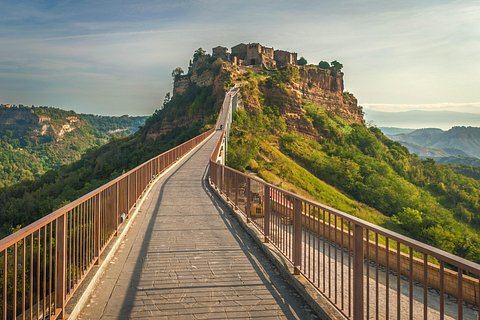
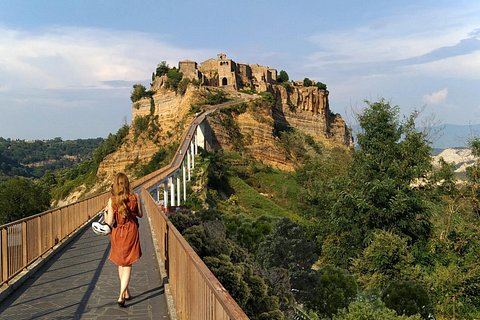
Civita di Bagnoregio, about 120 km north of Rome, is a village founded by the Etruscans on a plateau of soft volcanic tuff that erosion keeps wearing away, which earned it the name "the dying town." Only around a dozen people live there year-round, while remains of St. Bonaventure's birthplace survive. The only way in is on foot, across a reinforced-concrete bridge about 300 m long built in 1965 over the eroded badlands, ending at the Porta Santa Maria gate; entry to the village is paid. There is no train: the usual route is a train to Orvieto, about 20 km away, then a Cotral bus to Bagnoregio and a walk to the bridge, so combine the two in one day.
Quick facts
- Distance from Rome
- about 117 km by road
Sources · facts checked on 2026-11-16
- Civita di Bagnoregio – Wikipedia (en)
- Civita (Bagnoregio) – Wikipedia (it)
- Italia.it – Bridge of Civita di Bagnoregio
- Italia.it – Church of San Donato
- Italia.it – Civita di Bagnoregio
- Ministero della Cultura – Museo geologico e delle frane
- Bonaventure – Wikipedia (en)
- OSRM (OpenStreetMap routing) – Piazza Venezia to Civita
What Civita di Bagnoregio is
Civita is a hamlet of the town of Bagnoregio, in the province of Viterbo in northern Lazio, standing on a plateau of tuff at 443 m above the Valle dei Calanchi, a valley of eroded clay badlands. It lies about 1 km east of modern Bagnoregio and about 120 km north of Rome. The base of the hill is clay laid down by an ancient sea, which washes away easily, while the upper layers are tuff and lava, so the edges of the plateau keep breaking off and taking houses with them.
The writer Bonaventura Tecchi, who spent his youth here, gave it the nickname la città che muore, "the dying town." Only about ten people live in Civita year-round; in summer the bed-and-breakfasts bring more life. The village belongs to the association of I Borghi più belli d'Italia (the most beautiful villages in Italy), and in 2006 the World Monuments Fund put it on its watch list of 100 most endangered sites.
The bridge and the walk in
The only way in is a reinforced-concrete footbridge about 300 m long across the badlands, inaugurated in 1965. It replaced a series of temporary wooden walkways; an earlier masonry bridge from 1923 partly collapsed into the valley and was partly blown up by retreating German troops in 1944. The ridge of land that once joined Civita to Bagnoregio was destroyed by an earthquake in the late 17th century.
The walk starts at a viewpoint, drops gently, then climbs steeply to the gate, so wear comfortable shoes; the bridge is exposed and can be very windy. Residents and authorized people may cross by bicycle or motorbike at set times, but visitors walk. Entry to the village is paid: buy the ticket online or at the ticket office before the start of the bridge, and check the current fee and rules before you go.
What you see inside the village
You enter through Porta Santa Maria, also called Porta della Cava, the only survivor of the town's five gates. The two lions holding human heads above it recall a popular revolt against the Monaldeschi family. A tunnel cut through the rock, the Bucaione, leads from the village down to the Valle dei Calanchi.
The street plan follows a cardo and decumanus inherited from the Etruscans, but the houses are mostly medieval and Renaissance. The main square is dominated by the Church of San Donato, the town's cathedral until the late-17th-century earthquake forced the bishop to move to Bagnoregio. Its present form comes from Romanesque work of the 11th and 12th centuries, and two Etruscan sarcophagi carved in nenfro, a local volcanic stone, are built into the base of the bell tower. Inside is a 15th-century wooden crucifix of the school of Donatello; local tradition says it spoke to a woman to announce the end of a plague. Entry to the church is free.
On the same square, the Renaissance Palazzo Alemanni houses the Museo Geologico e delle Frane (Geological and Landslide Museum) on its second floor, which explains the geology of Civita and the Valle dei Calanchi, the historic landslides and the monitoring and stabilization work that keeps the village standing. Also in the village are the former Bishop's Palace, a 16th-century mill and the remains of the house where St. Bonaventure was born; the so-called Cave of St. Bonaventure, where legend sets his childhood healing by St. Francis, is in fact an Etruscan chamber tomb.
History: from Etruscan town to the dying town
The Etruscans founded the settlement on a route linking the Tiber valley to Lake Bolsena, and the Romans arrived in 265 BC. Both cut drainage channels and contained streams to slow the erosion; when that maintenance lapsed, the decline began. Civita later passed under the Goths and Lombards and eventually the Papal States.
St. Bonaventure, the Franciscan theologian who became the seventh Minister General of his order and a cardinal, was born here in 1221 and died in Lyon in 1274. By the 16th century Civita was being overshadowed by Bagnoregio, and after the late-17th-century earthquake the bishop and the town government moved there. Erosion sped up in the 19th century. The village has appeared in films including I due colonnelli (1962) and Questione di karma (2017), and Hayao Miyazaki said it inspired the floating city of Castle in the Sky (Laputa).
How to get there from Rome
There is no railway to Bagnoregio. The usual public-transport route is a train from Rome to Orvieto on the Florence–Rome line, then a Cotral bus from Orvieto to Bagnoregio, about 20 km away, then a walk to the start of the bridge. Check the Cotral timetable for both directions before you set out, so you are not stranded in Bagnoregio.
By car the drive from central Rome is about 117 km. Driving lets you combine Civita with Orvieto, whose cathedral and old town fill the other half of the day.
Tips for your visit
The village is small: an hour or two covers the streets, San Donato and the geological museum, plus time for the walk across the bridge and back. The best views of Civita on its outcrop are from the viewpoint at the Bagnoregio end of the bridge, before you start walking. The church's opening hours vary, so check in advance if seeing the crucifix matters to you.
On Good Friday evening the crucifix of San Donato is carried in a night procession from Civita to Bagnoregio.
What to see in Civita di Bagnoregio
The main sights, in the order you meet them after crossing the bridge.
Footbridge
Where From the Bagnoregio side
About 300 m reinforced-concrete walkway inaugurated in 1965, the only way in
Porta Santa Maria (Porta della Cava)
Where Village entrance
The only one of five gates still standing, with lions holding human heads
Church of San Donato
Where Main square
Former cathedral with a 15th-century wooden crucifix and Etruscan sarcophagi in the bell tower base
Museo Geologico e delle Frane
Where Palazzo Alemanni, Piazza San Donato
Geology, landslides and stabilization work at Civita and the Valle dei Calanchi
Cave of St. Bonaventure
Where Edge of the village
Etruscan chamber tomb linked by legend to the saint's healing
Bucaione tunnel
Where Below the village
Rock-cut passage leading down to the Valle dei Calanchi
Opening of the church and museum varies; check before you go.
Frequently asked questions
How do I get to Civita di Bagnoregio from Rome without a car?
Take a train to Orvieto, then a Cotral bus to Bagnoregio, then walk to the footbridge. There is no train station in Bagnoregio, so check bus return times first.
Do you have to pay to enter Civita di Bagnoregio?
Yes. Entry to the village is paid; tickets are sold online and at the ticket office before the start of the bridge. Check the current fee before you go.
How long is the bridge to Civita di Bagnoregio?
About 300 m. It is a pedestrian reinforced-concrete bridge built in 1965, with a steep final climb to Porta Santa Maria.
Why is Civita di Bagnoregio called the dying town?
Its plateau of tuff sits on easily eroded clay, so the edges keep collapsing and buildings have fallen into the valley. The nickname comes from the writer Bonaventura Tecchi.
How many people live in Civita di Bagnoregio?
About ten people live there year-round.
Can you visit Orvieto and Civita di Bagnoregio in one day?
Yes. Orvieto is the rail gateway to Civita, about 20 km away, so the two are usually combined in a single day trip.
Popular tours that include Civita di Bagnoregio
-
 Orvieto and Civita di Bagnoregio Full Day Private Tour from Rome
Free cancellationPrivate
(opens in a new tab)
-
 Escape to Civita di Bagnoregio & Orvieto from Rome
Free cancellationPrivate
(opens in a new tab)
-
 PRIVATE Civita di Bagnoregio and Orvieto Wine Tasting -Ebike tour
Free cancellationPrivate
(opens in a new tab)
Affiliate link Viator · If you book through this link, we may earn a commission at no extra cost to you.